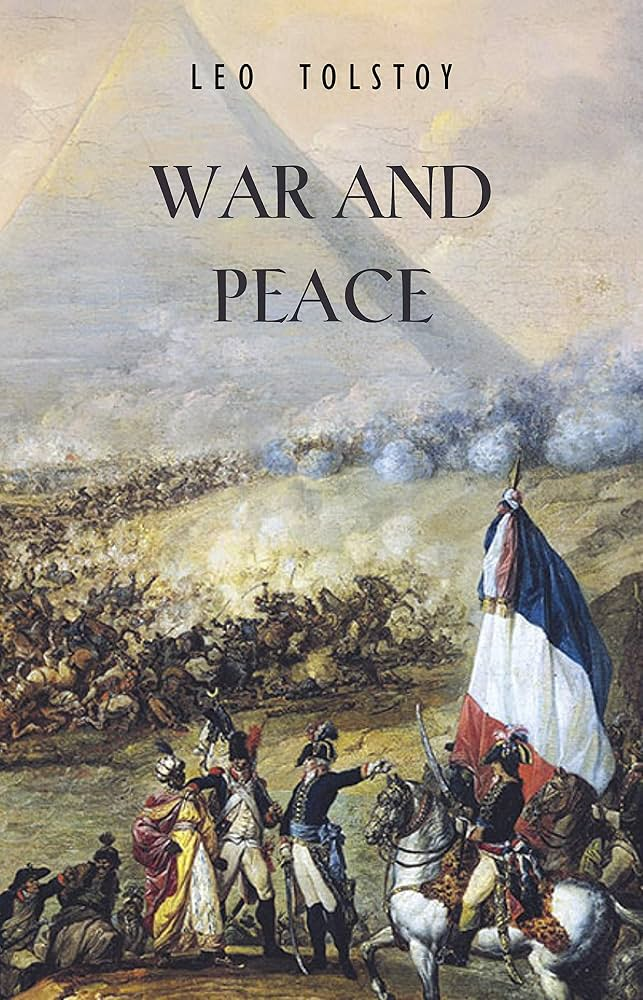
Tolstoy constructs a macro-scale field theory where individuals behave like particles buffeted by historical forces far larger than themselves. Napoleon is a heavy boson whose presence distorts the entire energy landscape, yet Tolstoy insists his influence is statistical, not causal: no single agent determines the trajectory of nations. Pierre, Natasha, and Andrei move through these fields as charged bodies responding to invasions, passions, and moral collisions. War is high-energy physics—unpredictable, chaotic, governed by probabilities rather than intentions. Peace is the low-energy phase where human interactions become legible again. Tolstoy undermines the notion of “great men” by treating them as excitations in a collective field rather than autonomous sources of force. The novel’s grandeur comes from this physics: a vision of history as a vast superposition of wills, all interfering, canceling, amplifying, and drifting toward equilibrium. Human meaning is found not in control but in the acceptance of our limited cross-sections.
Tolstoy’s masterpiece is also a planetary Polyphonon, with characters functioning as interlocking agent-fields across historical, philosophical, and domestic scales. Narraton (N) proliferates through multiple arcs; Temporalons (T) warp time between battlefields, salons, and contemplative essays. War provides massive Dissonatons, but Tolstoy dissipates them through a statistical model of history in which individuals are vectors in a larger momentum field. Silention (S⁰) appears in the void between personal desires and impersonal historical force. Metaphorons (Mγ) illuminate fate, freedom, and the rhythms of nature. The novel forms a macro-Mythoplasma of Russian identity.
