
The Vedas operate like foundational field equations: hymns that set cosmological symmetries, ritual operators, and priestly mediators that maintain the sacrificial vacuum. Their liturgies are bosonic actions transmitting sacred charge between human and cosmic realms. The sacrificial system establishes selection rules that regulate social stratification and perform energy transfers (offerings), preserving cosmic order (ṛta). In … Continue reading 5. The Vedas (India)
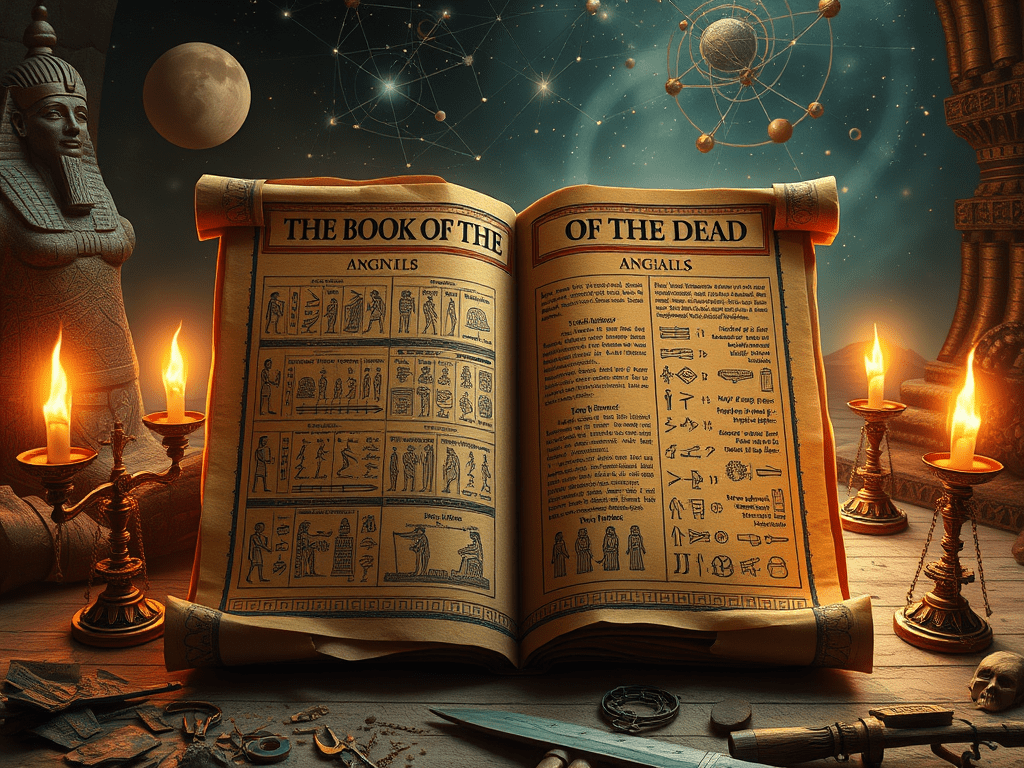
4. The Book of the Dead (Ancient Egypt)
The Book of the Dead functions as a manual for traversing the post-mortem vacuum: a set of boundary conditions and selection rules for the soul-field’s passage through the underworld. Each spell is a local operator altering the probability amplitude of safe passage—preserving identity-mass against decay. The heart-weighing scene is a literal measurement device: the scales … Continue reading 4. The Book of the Dead (Ancient Egypt)
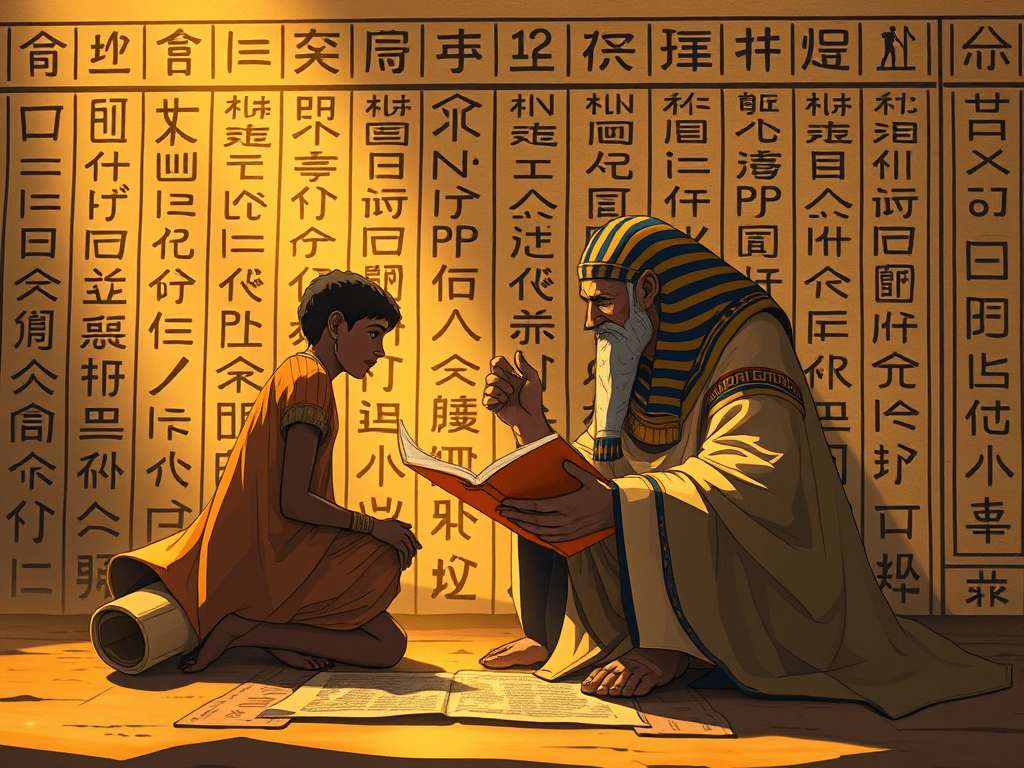
3. The Instruction of Ptahhotep (Ancient Egypt)
The Instruction of Ptahhotep is a low-energy effective theory: a compact Lagrangian of social rules that regulate interaction in an Egyptian legal-gauge. Its aphorisms act like conserved currents—protocols that minimize conflict and stabilize the civic vacuum. Each proverb functions as a mediated interaction (gauge boson) transmitting authority from elder to younger generations. The "mass" these … Continue reading 3. The Instruction of Ptahhotep (Ancient Egypt)

2. The Tale of Sinuhe (Ancient Egypt)
The Tale of Sinuhe reads as an early field-theory experiment in identity and exile. Sinuhe is a fermionic excitation displaced from the Egyptian vacuum by war and rumor; his wandering through Levantine courts resembles a particle propagating through different media with varying coupling constants—hospitality, dishonor, foreign custom. Egypt itself functions as a dominant Higgs-like background … Continue reading 2. The Tale of Sinuhe (Ancient Egypt)

1. The Epic of Gilgamesh (Mesopotamia)
Gilgamesh is a prototypical heavy excitation resisting mortality. Enkidu’s entrance turns the two into a bound pair, like a baryonic composite stabilized by intense mutual coupling. Enkidu’s death is a perturbation that shifts Gilgamesh’s vacuum: the hero gains existential mass—grief, wisdom—forcing a search for permanence (immortality) that results in a renormalized appreciation of the communal … Continue reading 1. The Epic of Gilgamesh (Mesopotamia)

Toward a Standard Literary Model
This post proposes a speculative yet disciplined framework for reimagining world literature: the Standard Literary Model (SLM). Inspired by the elegance of the Standard Model of particle physics, the SLM treats stories not as static cultural objects but as fields, forces, and interacting particles within a vast narrative cosmos.The goal is not to collapse literature … Continue reading Toward a Standard Literary Model

Art, Conceptualism, and the Universe.
Until very recently I hated conceptualism. Till I came across a piece written by Eric Wayne, an artist and art critic who wrote an article called “Why People Hate Contemporary/Conceptual Art”. It shifted my perception of conceptualism into a higher gear. In conceptualism, the idea or concept behind the work became more important than the … Continue reading Art, Conceptualism, and the Universe.

An Author’s Thoughts about Literary Criticism.
I just take sometimes offence at some critics who base their weighting of a novel on a very narrowly defined scale and sometimes these scales are provided by academics whose job it is to provide an informed opinion about them and not some biased fodder.
The Moral Crusaders and Literary Criticism.
Once an artist releases a product, it stands on its own and must be judged as such. The only views and opinions that count, are those ventilated or provoked by the artistic creation itself.

Pseudo-intellectualism in Modern Literature.
People who presume, not-entirely-unreasonable, that "literary fiction" represents a value judgment, fail to understand that "literary fiction" is just a marketing category (coined in the 1970's by publishing and book retailers) characterized by slower pacing, stylized prose, introspection and a focus on interior life over exterior action, a focus on character over plot. What they are not, though, are inherent markers of quality.

The Anatomy of a Best-Selling Book.
The average length of a best seller is 375 pages, set inside the USA and the protagonist is a female lawyer or detective. Romance is an upcoming segment: from 5 % of the sales in 1994 to 40 % on Amazon today and it has been demonstrated that men have a slight preference for a male main protagonist.

Critics; can’t live with them, can’t live without them.
Sometimes, one of the toughest things we hear in a day is criticism. We never want to hear that we are not doing something the right way.
 The Maharajagar