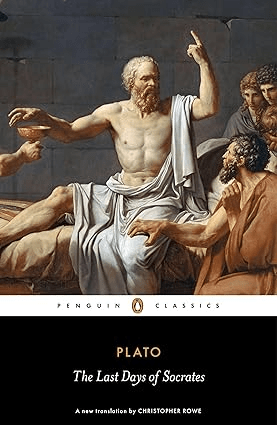
Socrates appears as a stable particle within a decaying moral field, a disruptive force whose questions unsettle the Athenian vacuum. His method—elenchus—is a controlled collision: ideas smashed together until hidden structures emerge. The trial reveals a society terrified of intellectual ionization—fearful that too much inquiry will shatter its fragile civic bonds. Socrates refuses to adjust … Continue reading 13. The Trial of Socrates (or Apology) — Plato
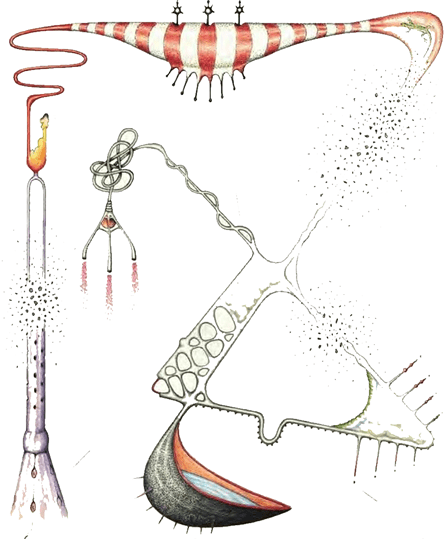
Page of the Combustion Beast
Poetic exploration of fire imagery as symbolic and elemental understanding of creative energy
11. Zhuangzi — Zhuang Zhou (China)
Zhuangzi destabilizes fixed identity-mass by questioning categories and promoting adaptive superpositions. His parables encourage flexible couplings, suggesting that rigid potentials lead to suffering; in SLM, he prescribes dynamic renormalization—allowing states to be context-dependent rather than fixed invariants. The Zhuangzi operates as a philosophical Mythoplasma, intertwining N + Mγ + T to create drifting parables whose … Continue reading 11. Zhuangzi — Zhuang Zhou (China)
10. Tao Te Ching (Dao De Jing) — Laozi (China)
The Daoist text describes a low-action algorithm: minimize forcings, align with natural flows, and the system self-organizes. Its advice acts like a dissipative operator removing excess energy and allowing emergent order. In SLM terms, the Dao is a prescription for constructing a nonintervening Higgs field: less deliberate action produces more sustainable identity mass by aligning … Continue reading 10. Tao Te Ching (Dao De Jing) — Laozi (China)
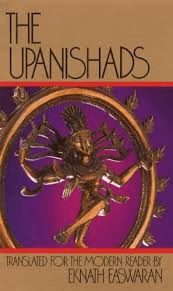
6. The Upanishads (India)
The Upanishads function as renormalization techniques for inner life. They propose methods for subtracting superficial divergences—ego, desire—to reveal a more fundamental field of Brahman. Practices they recommend (meditation, ethical discipline) are operators reducing self-interaction terms and allowing consciousness to experience unified modes. In SLM, the Upanishads describe a path to lower-energy coherence: when the individual … Continue reading 6. The Upanishads (India)

5. The Vedas (India)
The Vedas operate like foundational field equations: hymns that set cosmological symmetries, ritual operators, and priestly mediators that maintain the sacrificial vacuum. Their liturgies are bosonic actions transmitting sacred charge between human and cosmic realms. The sacrificial system establishes selection rules that regulate social stratification and perform energy transfers (offerings), preserving cosmic order (ṛta). In … Continue reading 5. The Vedas (India)
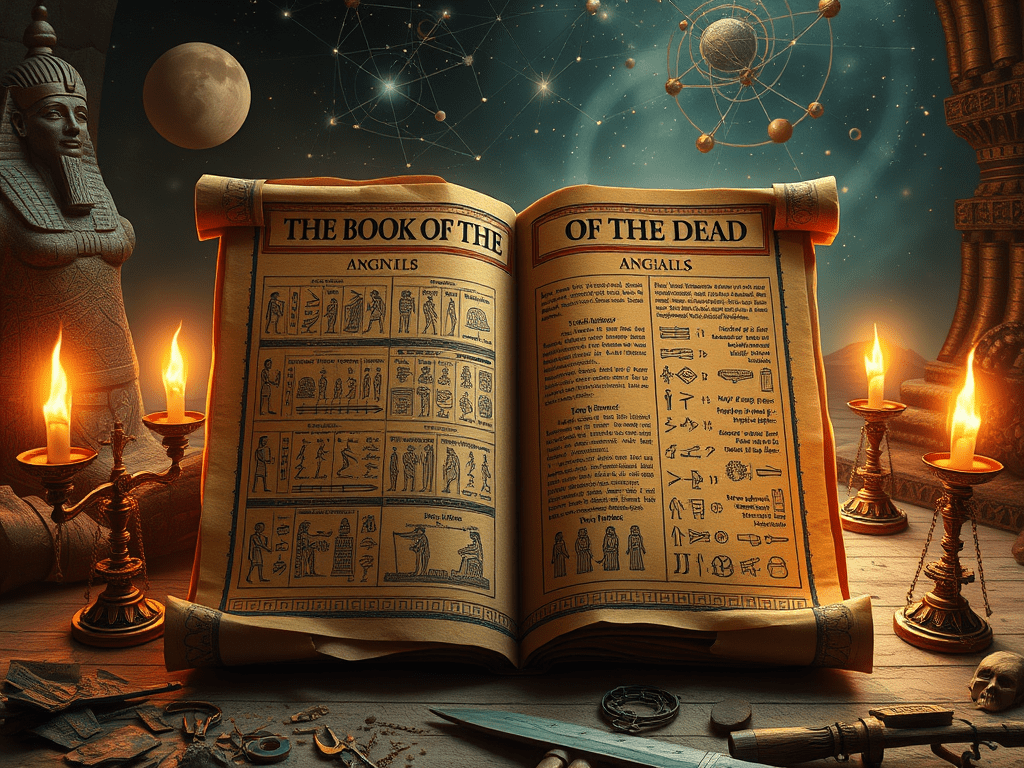
4. The Book of the Dead (Ancient Egypt)
The Book of the Dead functions as a manual for traversing the post-mortem vacuum: a set of boundary conditions and selection rules for the soul-field’s passage through the underworld. Each spell is a local operator altering the probability amplitude of safe passage—preserving identity-mass against decay. The heart-weighing scene is a literal measurement device: the scales … Continue reading 4. The Book of the Dead (Ancient Egypt)
3. The Instruction of Ptahhotep (Ancient Egypt)
The Instruction of Ptahhotep is a low-energy effective theory: a compact Lagrangian of social rules that regulate interaction in an Egyptian legal-gauge. Its aphorisms act like conserved currents—protocols that minimize conflict and stabilize the civic vacuum. Each proverb functions as a mediated interaction (gauge boson) transmitting authority from elder to younger generations. The "mass" these … Continue reading 3. The Instruction of Ptahhotep (Ancient Egypt)

2. The Tale of Sinuhe (Ancient Egypt)
The Tale of Sinuhe reads as an early field-theory experiment in identity and exile. Sinuhe is a fermionic excitation displaced from the Egyptian vacuum by war and rumor; his wandering through Levantine courts resembles a particle propagating through different media with varying coupling constants—hospitality, dishonor, foreign custom. Egypt itself functions as a dominant Higgs-like background … Continue reading 2. The Tale of Sinuhe (Ancient Egypt)

1. The Epic of Gilgamesh (Mesopotamia)
Gilgamesh is a prototypical heavy excitation resisting mortality. Enkidu’s entrance turns the two into a bound pair, like a baryonic composite stabilized by intense mutual coupling. Enkidu’s death is a perturbation that shifts Gilgamesh’s vacuum: the hero gains existential mass—grief, wisdom—forcing a search for permanence (immortality) that results in a renormalized appreciation of the communal … Continue reading 1. The Epic of Gilgamesh (Mesopotamia)

Toward a Standard Literary Model
This post proposes a speculative yet disciplined framework for reimagining world literature: the Standard Literary Model (SLM). Inspired by the elegance of the Standard Model of particle physics, the SLM treats stories not as static cultural objects but as fields, forces, and interacting particles within a vast narrative cosmos.The goal is not to collapse literature … Continue reading Toward a Standard Literary Model
Alec and Millie: The Dreamers Who Started It All
Before the shrines, before the war, there was simply Alec and Millie—a journalist and his wife in neutral New York, 1914. What begins as a cultural prank—swapping museum bones in protest—becomes the spark that reawakens ancient orders. Millie, touched by voodoo and prophecy, carries twins destined for divine possession. Alec, haunted by what he sees … Continue reading Alec and Millie: The Dreamers Who Started It All

How do the 3 metathemes relate to the content of the Maharajagar?
Let’s now explore how those three meta-themes (as described in the foreword) integrate with the content, structure, and symbolism of The Maharajagar across the whole saga: "The All is a projection of informational modulated energy waves by a cosmically horizon on the time-space continuum."Interpretation in the series:This is a deeply metaphysical idea—drawing from quantum field … Continue reading How do the 3 metathemes relate to the content of the Maharajagar?

What is the Maharajagar about?
The Maharajagar is an epic, genre-blending saga of myth, memory, and power, set against the shifting backdrops of early 20th-century Earth and beyond. Rooted in historical fantasy and inspired by the structure of the Mahabharata, the series traces the paths of a diverse ensemble of characters bound together by fate, ancient forces, and a mysterious … Continue reading What is the Maharajagar about?

Reshuffling my Art and Finding my own Style.
I decided to pause the report of my quest into the canon of the world literature because there was a similar hiatus in my exploration process back then in 2015 that actually lasted till May 20th, 2015. Instead I'm going to expand a little bit upon how I've recently developed my own artist's style or … Continue reading Reshuffling my Art and Finding my own Style.

An Emporium of Order and Chaos.
The title and image of this post refer to an artistically diary in which I’m resuming and catalogizing my artistic and literary creations, larded with thoughts, philosophies, and observations that induced them.The chronological order in which the works were produced has been abandoned in favor of a systematic approach were the subjects are brought together … Continue reading An Emporium of Order and Chaos.

About Transcribing Finnegans Wake in plain English.
The primary transcription goal of Finnegans Wake into Here Comes Everybody’s Karma (isbn 9781737783299) was to open Joyce’s Opus Magnum for a wider reading public by replacing the foreign language idiosyncrasies with an English equivalent and by streamlining Joyce’s sibylline prose.This required me to engage with the prose of Finnegans Wake that goes beyond that … Continue reading About Transcribing Finnegans Wake in plain English.
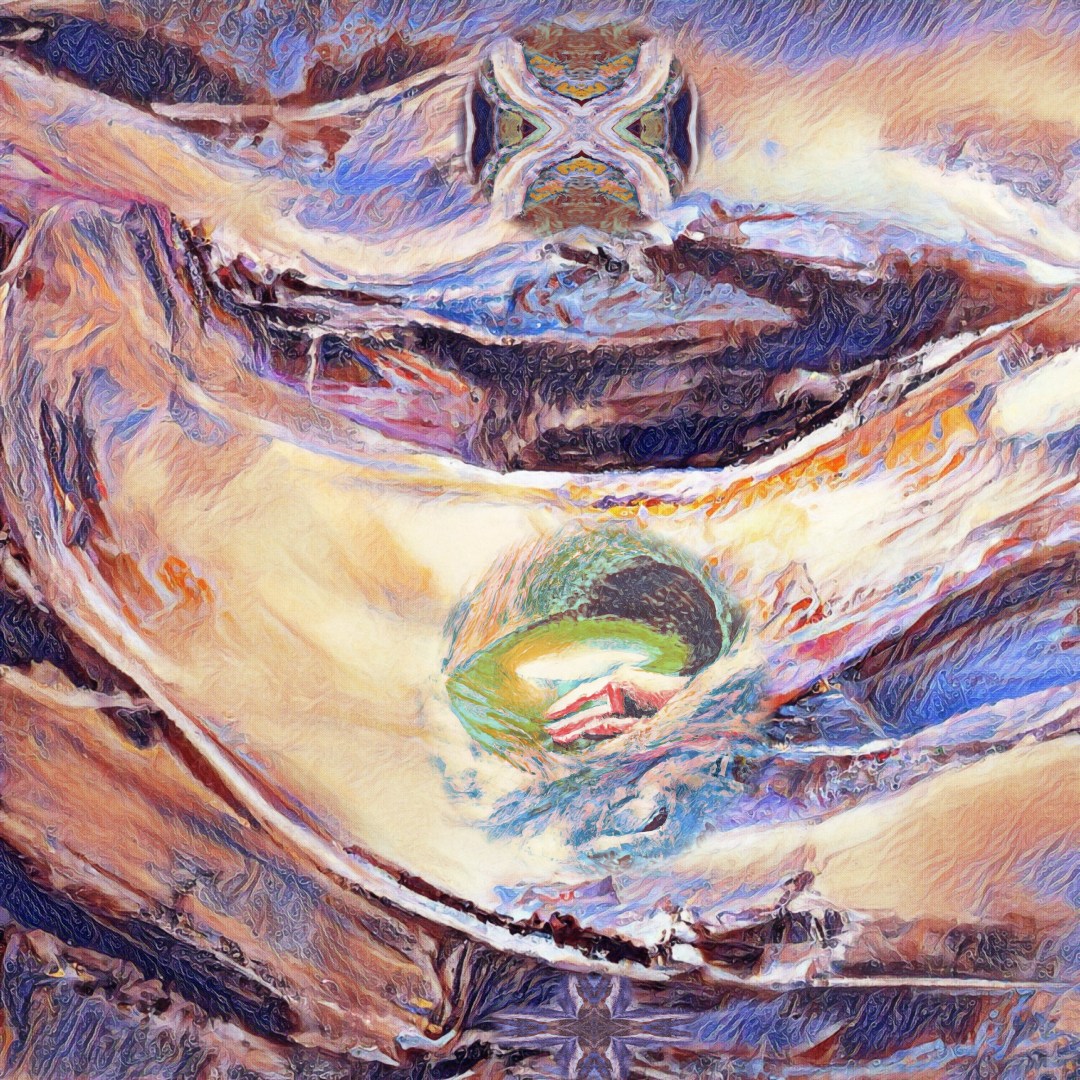
Being Water, digital collage of previous works, canvas 80 x 80 cm, 2024.
The background of this work is based upon the concept of dynamics that challenges our perception of fixed borders and boundaries. The seven oceans are an example to illustrate how the arbitrary lines imposed by humans can limit our understanding of the interconnected systems of the world. Dynamics blurs the distinctions between land and sea, … Continue reading Being Water, digital collage of previous works, canvas 80 x 80 cm, 2024.

The Infinite Universe of Pi.
Although I have at this instance a very busy schedule, it seems that I can't keep going without distracting myself every now and then with some artistic project. The idea for this work occurred to me during the night and I couldn't focus on anything else till I had it worked out. It's a digital … Continue reading The Infinite Universe of Pi.
A Society in Transit. Expanded catalog, 166 p., isbn 9798865037835, by Shaharee Vyaas ( Kindle version $ 4,99)
Click on this image to be directed to the amazon page. Arundhati Roy //The system will collapse if we refuse to buy what they are selling…their ideas, their version of history, their wars…their notion of inevitability. Remember this: We may be many, and they be few… Another world is not only possible, she is on … Continue reading A Society in Transit. Expanded catalog, 166 p., isbn 9798865037835, by Shaharee Vyaas ( Kindle version $ 4,99)
 The Maharajagar