
Raskolnikov is a split particle—two incompatible wavefunctions occupying the same moral space, oscillating between cold rationality and unbearable empathy. His crime is a violent symmetry breaking meant to prove he exists outside human norms; instead it exposes him to the weak force of conscience, a subtle interaction that decays even the strongest self-justification. Sonia acts as a stabilizing boson, introducing a new coupling to love that gradually renormalizes his fractured identity. The city of St. Petersburg is a thermal bath, raising the system’s energy to feverish levels, making every encounter feel like stochastic noise. The murder itself is a failed measurement: an attempt to collapse his destiny into greatness that instead reveals only guilt. Redemption arrives not through logic but through a reconfiguration of internal charge—an acceptance that no one escapes the interconnectedness of human fields. Dostoevsky’s physics is theological, yet strangely compatible with modern theory: no particle is free; everything interacts.
Raskolnikov is an unstable particle convinced he belongs to a higher symmetry class of humanity. His theory of extraordinary individuals functions like a flawed gauge model—elegant in abstraction, catastrophic in application. The murder of the pawnbroker is a symmetry-breaking event releasing moral radiation he cannot reabsorb. Guilt becomes the force that binds him to reality, acting on him like an invisible boson whose pressure increases the longer he resists confession. Sonya is the novel’s Higgs field: a quiet presence whose compassion grants Raskolnikov the mass of genuine remorse, allowing him to re-enter the human spectrum. Porfiry Petrovich performs psychological scattering experiments, probing Raskolnikov’s defenses until the truth emerges as a decay product. In the end, redemption is not a sudden transformation but a slow renormalization—a recalibration of self under the weight of suffering.
Dostoevsky generates an intense Realiton in which Raskolnikov’s psychology becomes a particle chamber of oscillating Dissonatons (D±)—pride, guilt, ideology. The murder constitutes a catastrophic Symmetry break, shattering his internal gauge balance. Silention (S⁰) permeates the suppressed emotional truths he refuses to confront. Metaphorons (Mγ) illuminate the moral and theological stakes, while Temporalons (T) dislocate time through fever, hallucination, and confession. Sonya functions as a stabilizing Polyphonon, introducing compassion into the moral field. The novel ends in a fragile re-mass-generation: the possibility of redemptive meaning.
Fundamental Particles
| Particle | Symbol | Function |
| Narraton | N | The basic storytelling particle. |
| Metaphoron | Mγ | The carrier of imagery; analogous to a photon. |
| Dissonaton | D± | Conflict, rupture, contradiction. |
| Silention | S⁰ | The unsaid, the erased. Appears only via absence. |
| Polyphonon | P³ | Multi-voiced narration; binds communities. |
| Temporalon | T | Manipulates chronology. |
Composite Particles
(Produced when fundamental particles bind.)
| Composite | Composition | Literary Equivalent |
| Mythoplasma | N + Mγ + T | Myth, epic cycles, cosmologies. |
| Realiton | N + D± | Realist narrative, social conflict. |
| Memoirion | N + S⁰ + T | Memory narrative, trauma narrative. |
| Fictionon | N + Mγ | The creative continuum. |
| Critical Gluon | P³ + D± | The force binding literary traditions. |
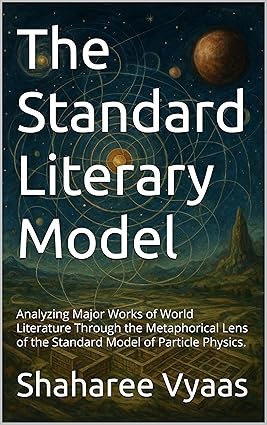
| Kindle eBook publishing Submitted on November 19, 2025 | $3.00 USDView on Amazon ASIN: B0G2YTJK5Y |
| Paperback Live Submitted on November 20, 2025 | $9.99 USDView on Amazon ASIN: B0G31YM7GR |
