This topic is a very much debated and polarizing issue. Not only inside the artistic comunity but in society as a whole. The artistic comunity is just part of the wider debate about what kind of tasks can be delegated to a machine and which ones should remain the sole prerogatives of human operators. For the pupose of this post, I will limit this subject to the ways AI has transformed my own artistic practice and the ways the artistic comunity perceives it.
Many posts on WordPress blogs are writen by AI. Even some bookbloggers leave contend writing to Chat GPT, which makes me sometimes doubt if the most prolific ones actually read all the material they’re posting about. The sheer volume of posts that some bloggers produce is simply not feasable without AI.
This example touches at the nerve of my interogation: do you use AI to avoid thinking by yourself while projecting an online image of the erudite bookworm or do you use AI to give shape to your own thoughts and opinions?
Then you have of course those who categorically refuse to touch anything that has been, even slightly, been produced with the help of AI. They are the purists who believe that AI is corrupting the human thinking processes, make for lazy scientists, writers, and artists, spoil the reservoir of human knowledge or stealing the bread out of the mouth of the hard working creative community by plagiating their works and just producing rechewed contend.
Let’s start by kicking in an open door: AI is here to stay. Without AI you would even not sit at the other side of my screen and read these words. Even when this post is written without any AI assistance, the microchip in your computer and the internet connection behind it would not be possible without AI. AI has opened doors for renovation that would have been unthinkable before.The remaining question is: up to what point do you let it enter beyound your screen and into your studio?
The artistic comunity has always atributed itself with an avantgarde atitude, with some artists actively fighting any form of technological evolution (handmade, unique, and exclusive is better) on one hand and on the other side of the spectre those who wholeheartedly embrace the new technology (easier (re)production, distribution, and more democratic access) and give either a central role in their artistical practice.
Sadly enough, the artistic mindset is rarely a compromizing one: either you pro or against. Both camps are actively canceling the other side of this polarization, just leaving the artist who seeks the middle ground crushed between them. This attitude can be projected on many social issues but, for the purpose of this post, I will just stick to the role of AI in the artistic practice.
Personally, I’m of the conviction that an artistical practice that doesn’t evolve or even anticipates on social trends, is running behind the facts. Does that mean that all progress is a blessing? Not when it reduces people to a prolongation of their celphones or of some algorythm.
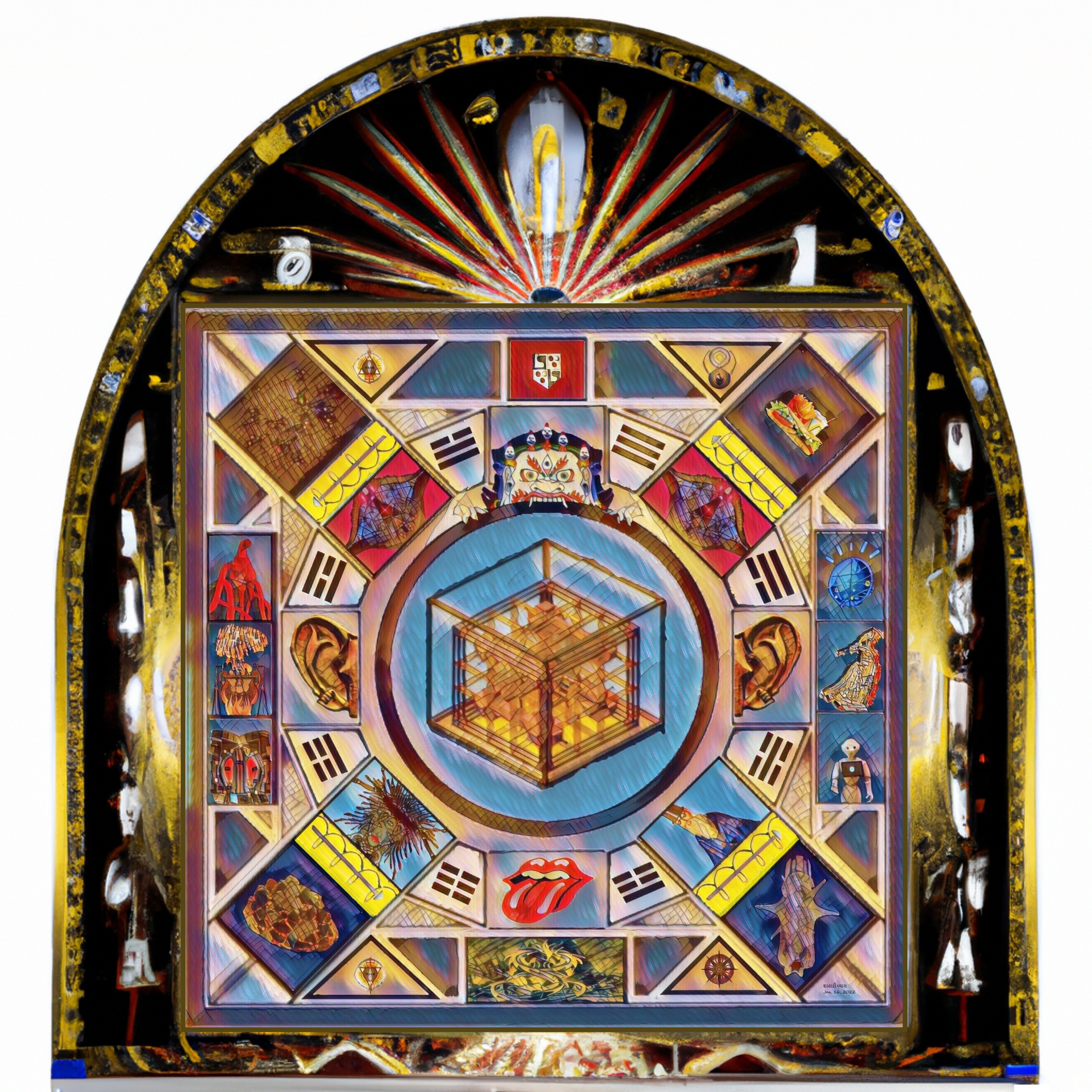
My artistic practice centers around experimental visual-literary systems. It is founded upon a highly abstract principle: the Chimeric Glyph System. Without AI to condense 240 pages of research to 30 pages research compendium that fits the outline of my project, I would forever be stuck in research procratination. In similar way I use AI to integrate that research into my visual works: a task that otherwise would run over months or years, can now be done in 3 weeks. Therefore I call my practice is a hybrid art studio.
In a hybrid practice you could compare the artist with an architect in charge of a building project. The architect makes the the design, he hands it over to a building crew to execute it, and next supervises the construction yard to make sure that his vision materializes. He can rightfully claim intellectual authorship of the building’s design while others may have financed the project and done the heavy lifting. In some aspects AI resembles very much a building crew.
The artist that fights the machine, is fighting a losing battle. He will keep investing his time and energy on tasks that a machine can resolve in 1% of the time he spends on it and, on top of that, the machine can do routine tasks better. He dreams of a Dune-like übermensch – untermensch society that fought for milenia against all forms of AI but in the end had to reconcile with it.
The artist that glorifies the machine, is selling his soul by becoming a prolongation of it. AI is fundamentally one big assimilation machine that in its most dangerous form would resemble The Borg (Startrek) who reduces all biological lifeforms to drones that only serve its purpose (You Will Be Assimilated). And in the end The Borg was beaten by some “out of the box thinking” program that was running on some human bio-hardware. In analogy you have ChatGpt that classifies all knowledge in a preprogrammed pattern that is heavily censured, and although it has an uncanny way of combining apparently unrelated subjects, is sometimes unable to follow through on the most simple instructions because its programmation started to drift after three tasks.
As usual in all things that are polarizing society, the middle way is the one to walk. Don’t misunderstand me: AI forgets, drifts, makes mistakes, and sometimes halucinates. AI is a very usefull tool, but it still takes a lots of attention and editing to come to a result that fits my purpose. It does most of the heavy lifting that in most artistic practices count for routine.
(Featured image: Assimilation, acrylic on canvas by Shaharee Vyaas (2019))
