
The Maharajagar is an epic, genre-blending saga of myth, memory, and power, set against the shifting backdrops of early 20th-century Earth and beyond. Rooted in historical fantasy and inspired by the structure of the Mahabharata, the series traces the paths of a diverse ensemble of characters bound together by fate, ancient forces, and a mysterious … Continue reading What is the Maharajagar about?
An impending book launch: The Maharajagar
I know that I'm a poor internaut. When inspiration strikes me, I just disappear in my studio and the blogosphere will have to keep running without me. It probably saddled me up with a a couple of D's in its subroutine. To blog is to be on the internet. Now what happened that I risked … Continue reading An impending book launch: The Maharajagar
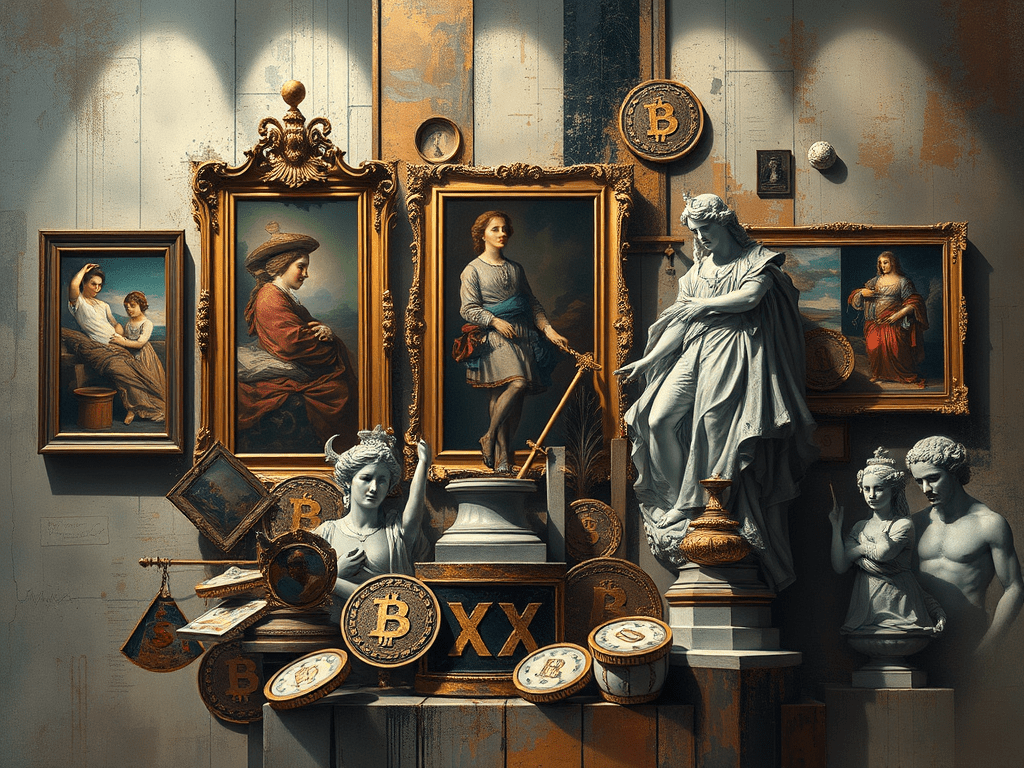
The contemporary critical art theory
A common critique of the art world is the emphasis on financial gain over critical engagement with art theory. Many artists feel that the focus on monetization, particularly through NFTs and other speculative markets, overshadows the potential for deeper artistic and social commentary. This can lead to a situation where artistic merit is secondary to … Continue reading The contemporary critical art theory
Carefully chosen adventures, within a framework of personal security, can lead to greater fulfillment.
Daily writing promptAre you seeking security or adventure?View all responses
Reading the canon of world literature
Chapter 21; Ulysses by James Joyce.July 15th, 2015Description Quotes in Ulysses;- The mirror is the instrument of the narcist and solipsist, the broken looking glass is the instrument of the artist.- History is my reversal omnibucal cord to humankind. It’s nothing that I suffer from, but something I keep contributing to.- Is a ghost any … Continue reading Reading the canon of world literature
Geographies
Last week I submited some contribution to an open call launched by LoosenArt who is inviting photographers, video makers and digital visual designers to take part in the collective exhibition "Geographies: an exploration between places, environments and cultures", an exhibition project that seeks to question and narrate the many forms of contemporary geography: physical and … Continue reading Geographies
Reading the canon of World Literature
Chapter 20; Father Goriot by Honore de Balzac.July 2nd, 2015Summary Most of the action is centered around a boarding house called Maison Vauquer, ran by a widow, Mme. Vauquer. The story relates mostly to the interactions between Jean-Joachim Goriot, a retired vermicelli maker who bankrupted himself to give his daughters a better future; a secretive … Continue reading Reading the canon of World Literature
Is the Pen really mightier than the Sword?
The phrase "the pen is mightier than the sword" was first written by English novelist and playwright Edward Bulwer-Lytton in his 1839 play Richelieu; Or the Conspiracy. It may be true that history is full of people who have never personally held any type of weapon and have nevertheless sent millions to an early grave. … Continue reading Is the Pen really mightier than the Sword?
North American Literature and the Universe.
Since American literature, as represented by the collection of the US Library of Congress, has the whole universe as a subject, one could assume that this system is also governed by the same mechanisms that it describes. UNIVERSE Alan Guth believes that the universe bubbled up out of a pre-universal singularity. During a short moment, … Continue reading North American Literature and the Universe.
Reading the Canon of World Literature
Chapter 19; The Adventures of Huckleberry Finn by Mark TwainJune 25th, 2015This book counts 366 pages and was first published in 1884 in the UK and a year later in the US. It played mainly along the Mississippi River into a pre-civil war society that already 20 years ceased to exist by the time the … Continue reading Reading the Canon of World Literature
A Synopsis of US literature: Science Fiction
An answer to Pynchon’s question "What comes now?" is heavily explored by an often-neglected facet of US literature; science fiction, a genre that contemplates possible futures. Because science fiction spans the spectrum from the plausible to the fanciful, its relationship with science has been both nurturing and contentious. HG Wells who, by most critics, is … Continue reading A Synopsis of US literature: Science Fiction
A Synopsis of US literature: 1960 – 1980.
The 1960s, a period often called the "Sixties" or the "Swinging Sixties," were characterized by significant social, political, and cultural shifts. Key themes included the fight for civil rights, the Vietnam War, the rise of the counterculture, the sexual revolution, and the beginning of the feminist movement. The decade witnessed both optimism and upheaval, with … Continue reading A Synopsis of US literature: 1960 – 1980.
Synopsis of US literature: 1930 – 1960
In the early thirties, the first reaction to the depression was a literature of social protest. The failure of the American dream became the main theme in Jewish-American literature. The novel “Call it Sleep" mixes Marxism and Freudian theory, Jewish mythology and a stream of consciousness writing style. Farrell writes more about spiritual poverty then … Continue reading Synopsis of US literature: 1930 – 1960
A synopsis of US literature: 1910 – 1930.
On December 11th, 1910, the human character changed, and the modernist consciousness founded itself upon the inherent instability of the new relative worldviews. Suddenly humankind was lost in a relativistic universe where there are no more rules that can be transgressed, and nobody can be accused of abnormality. The Chinese pagoda became popular in European … Continue reading A synopsis of US literature: 1910 – 1930.
A Synopsis of Us Literature: 1890 -1910.
In the 1890's, many realists became naturalists, a term created by Emile Zola. For them realism was an ideology and the novel had the power to become a political weapon. Crane had the view that life and death are determined by fate. He wrote about a man who said to the Universe "Sir, I exist! … Continue reading A Synopsis of Us Literature: 1890 -1910.
A sinsopsis of US literature: 1854 – 1890
European observers, who take a close look at the characteristics that they qualify as typical for white Americans, discover soon that they were originally attributes of the American Indian. The liberation from a social hierarchy and the idea that “all men are born equal” is also an American Indigenous invention that crossed the Atlantic Ocean … Continue reading A sinsopsis of US literature: 1854 – 1890
A sinopsis of US literature: 1810 – 1854.
1810 - 1840 is known as the Knickerbockers’ Era of American literature. The name comes from "A History of New York" by Dietrich Knickerbocker, a pseudonym of Washington Irving. It was a humorous rather than a serious history of the city. He invented many of the events and legends he wrote about in the book. … Continue reading A sinopsis of US literature: 1810 – 1854.
A Brief Sinopsis of US literature: 1735 – 1810.
In the early days of independence, American novels served a useful purpose. They used realistic details to describe the reality of American life. But when some of the good American literature started to arise above the time and place where they were written; these works became universal. The oldest examples are the sketches and observations … Continue reading A Brief Sinopsis of US literature: 1735 – 1810.
Reading the Canon of World Literature
Chapter 18; Don Quixote by Miguel Cervantes.May, 20th, 2015.Summary.The main character got introduced as Alonso Quixano, a financially independent old man who spends all his time on reading tales about medieval knights ‘s slaughtering dragons and saving princesses.He became so obsessed with this subject that one day he puts on his bet grandfather’s harness, changes … Continue reading Reading the Canon of World Literature
Reading and Location: Dublin and Finnegans Wake.
In Finnegans Wake, James Joyce uses various representations of Dublin, including the double-n "nn" (total negation) and the Irish name Baile Atha Cliath (Town of the Ford of Hurdles). Joyce often draws parallels between Dublin and other cities, believing that the particular can reveal the universal. This name appears frequently in the book, along with … Continue reading Reading and Location: Dublin and Finnegans Wake.
 The Maharajagar