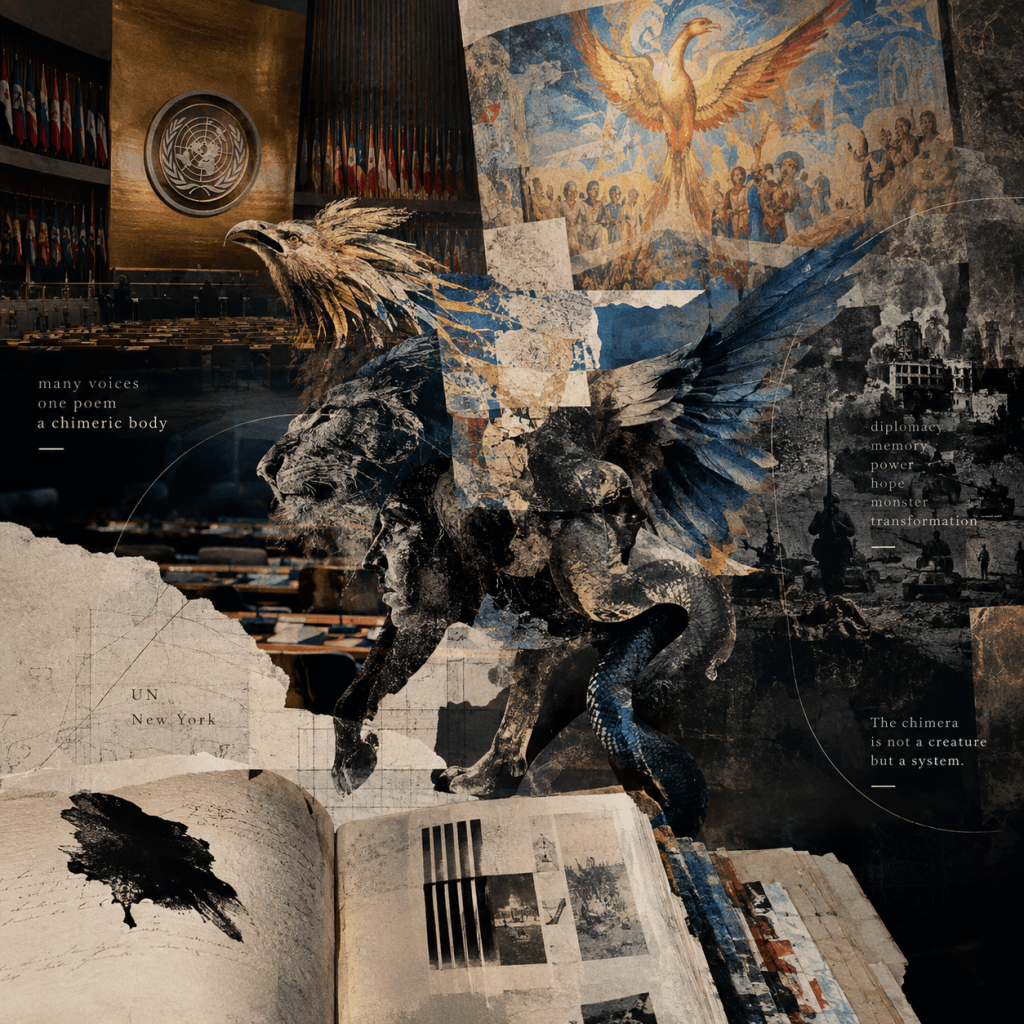
I went to Nadim Choufi’s A Dragon in the Halls of Diplomacy at Pickle Bar in Berlin expecting, perhaps, to encounter a work about diplomacy, monstrosity and political power. I did not expect to find myself thinking so directly about my own work.
The performance begins with a poet sending his editor his final poem and instructing him to find the monster for whom the poem was written: “You will know him when you see him.” What follows is a search through poetry, love, monstrosity and the institutional spaces of diplomacy. Choufi’s work is based on In the Face of the Dragon, a cento poem constructed entirely from lines borrowed from more than ninety Arab poets, many translated into English for the first time. The poem therefore already carries within itself a remarkable act of transmission: many voices are extracted from their original contexts and recombined into another body.
During the reading, my attention was repeatedly drawn toward the question of where the monster could be located. Much of the narration centred on the United Nations headquarters in New York and the political structures embodied there, particularly in relation to Palestine, the struggle for an independent state, peace, and the repeated failure of international politics to deliver either.
Later, the focus narrowed onto Per Krohg’s Untitled (Mural for Peace) in the UN Security Council chamber. The mural, installed in 1952, depicts a phoenix rising from a world covered in ashes. Its lower, darker section depicts suffering, war, soldiers, machinery and dragon-like imagery; above it, brighter scenes evoke peace, security, freedom and human renewal. The phoenix is explicitly described by the United Nations as a symbol of rebirth.
Eventually, the narrator comes to believe that the dark lower portion of the mural contains the monster his dead friend was referring to.
I found myself disagreeing.
What struck me much more strongly throughout the performance was the chimeric structure operating everywhere. The poem itself is chimeric: ninety-plus voices are brought together into one body. The UN becomes chimeric in another sense, with its many rooms, nations, languages, interests and political positions assembled within a single institution. The performance repeatedly moves between people, animals, landscapes, metaphors and political entities, creating bodies and identities that are continually changing form.
From that perspective, I don’t think the monster is located in the dark lower section of Krohg’s mural, or even in a single room of the United Nations.
Perhaps the monster is the chimera of the United Nations itself: an enormous composite body made from competing nations, aspirations, histories, ideals, failures and forms of power, presenting itself as a unified instrument while constantly revealing the contradictions within that unity.
This interpretation became even more interesting after I spoke with Choufi following the performance. He told me that he had already performed the reading around seven times, and that something changed each time. That immediately made me think of the chimera not simply as a hybrid creature, but as an agent of continual transformation. The work does not remain fixed even when the text remains substantially the same; each performance produces another configuration.
And unexpectedly, this brought me very close to a thread that my own work has been pursuing: the idea that meaning can emerge through combination, relation and transformation, rather than existing fully formed within any single component.
I went looking for a monster.
I came away thinking about the chimera.
