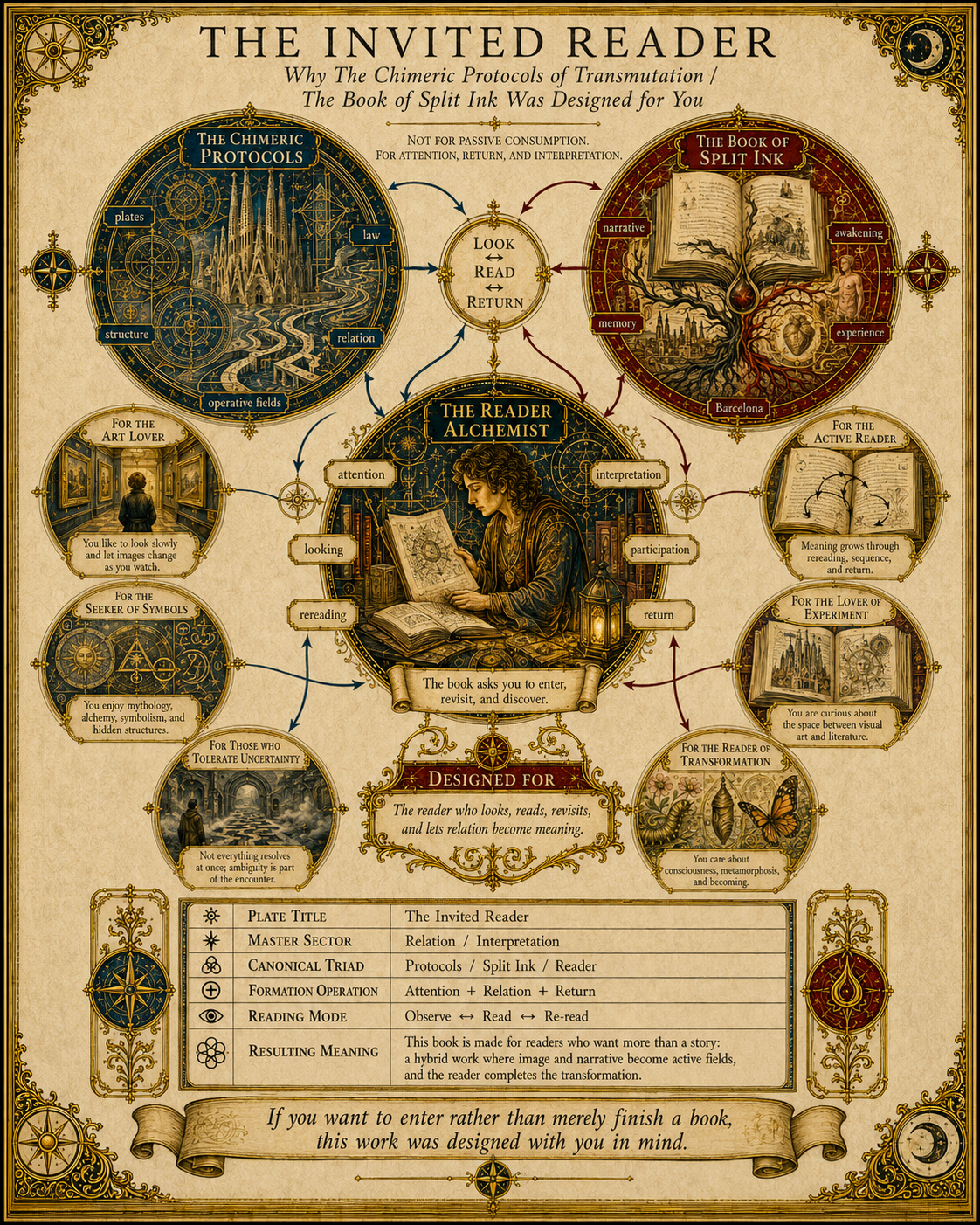
The Chimeric Protocols of Transmutation / The Book of Split Ink was not designed for a passive reader.
It was designed for the reader who likes to look as much as read, who is curious about the space between visual art and literature, and who does not mind entering a work that asks for attention, return, and interpretation.
If you have ever stood in front of a painting longer than expected because something in it kept changing as you looked, this book is for you.
If you enjoy fiction but sometimes wish a page could do more than carry sentences from left to right, this book is for you too.
At its core, the work is deliberately hybrid. The Chimeric Protocols are not illustrations added to a story; they are operative visual fields built from glyphs, pathways, structures, and laws of transformation. The Book of Split Ink gives those structures consciousness, body, memory, and experience through Gala and Salvador. The reader stands between them as a third participant—the Alchemist—moving back and forth between image and narrative.
That makes this book especially suited to art lovers. You do not need to approach each plate as something that must be instantly decoded. You can enter it the way you might enter a gallery: observe its balance, symbols, repetitions, tensions, colors, and strange details. The companion manual describes this approach as “form before meaning”: first notice geometry, orientation, scale, pathways, and relationships; interpretation comes afterwards.
It is equally intended for readers attracted to experimental fiction, surrealism, mythology, alchemy, consciousness, transformation, and symbolic systems. The work moves through botanical awakenings, anatomical mysteries, metamorphic machines, ritual structures, mythic histories, and the hidden layers of Barcelona.
But perhaps its ideal reader is simply someone who enjoys being asked to participate.
The Chimeric Glyphic System was conceived to create a territory in which an image can be read, a sentence can be seen, and a narrative can be navigated. Its ambition is not to replace written language, but to explore things prose struggles to represent simultaneously: recursion, networks, layered causality, memory, cycles, and transformation.
You therefore do not need prior knowledge of symbolic languages, semiotics, occult systems, or art theory. The work is designed to teach its visual grammar gradually. The intention is that the reader moves from needing explanations toward recognizing structures independently—becoming an active interpreter rather than a passive observer.
And you do not have to understand everything.
In fact, uncertainty is part of the experience.
Read a narrative. Look at its corresponding plate. Return to it later. Notice what changed because you now know more. Follow a symbol without immediately naming it. Allow an image to remain unresolved.
This book was made for readers who are comfortable with that kind of encounter: people who believe art does not always have to provide an answer, and literature does not always have to lead along a single path.
If you want a book simply to finish, this may not be the book for you.
But if you want a book to enter, revisit, examine, and gradually learn how to see differently, then it was designed with you in mind.
English edition: Vyaas, Shaharee. The Chimera Protocols of Transmutation. 254 pages, standard color. Independently Published, September 15, 2026. ISBN 9798255835324. Price: €29.99.
Edición española: Vyaas, Shaharee. Los protocolos quiméricos de transmutación y El libro de la tinta dividida. 254 páginas, color estándar. Publicación: 15 de septiembre de 2026. ISBN 978-84-09-88086-7. Precio: €29,99.
