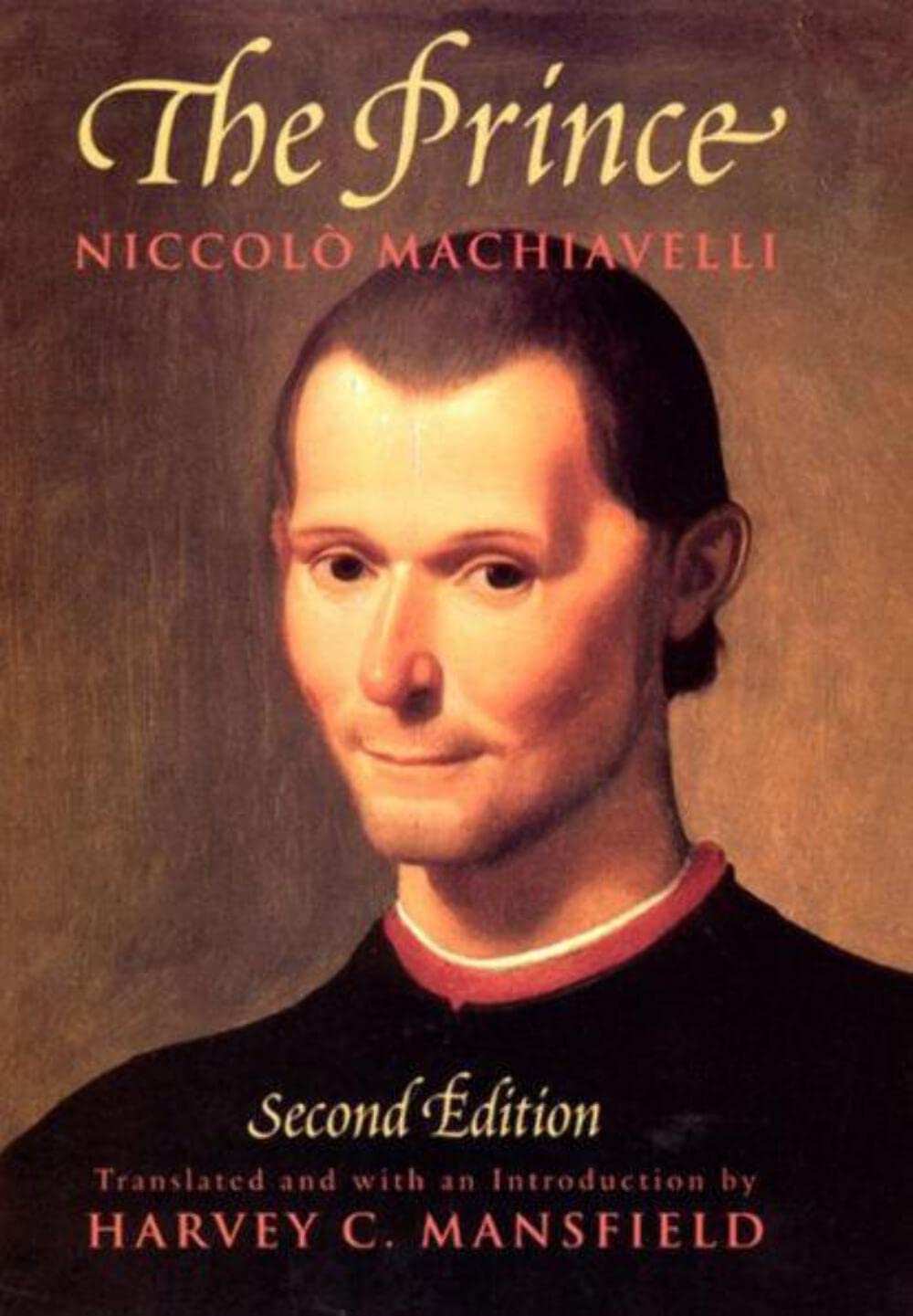
Machiavelli proposes a political Standard Model in which rulers must understand the fundamental forces governing human behavior. Fear and love are not moral categories but competing charges; a prince must balance them like electric and magnetic fields to maintain equilibrium. Fortuna is a stochastic force, unpredictable yet patterned, a turbulence requiring constant recalibration of strategy. Machiavelli discards metaphysical justifications for power, treating governance as an applied physics: observe, predict, intervene. Mercy, cruelty, generosity—these are tools, not virtues, each with measurable impact on stability. His realism resembles a renormalized theory cleansed of idealistic infinities. The prince who survives is not the noblest but the one who navigates shifting potentials with precision, adjusting to flux without losing coherence. Machiavelli’s brilliance lies in admitting that human systems are inherently unstable—and that mastery requires accepting their volatility. Machiavelli’s The Prince functions as a Realiton (N + D±): a narrative built from the raw Narraton (N) of political explanation fused with continuous Dissonaton (D±)—the frictions of war, betrayal, contingency, and human ambition. Its voice is didactic but strategically performing a Critical Gluon (P³ + D±): it binds political history, classical precedent, and Florentine crisis into a single, force-carrying analysis that holds together competing traditions of statecraft. The work orbits around Machiavelli’s central proposition: that political stability emerges not from virtue in the moral sense but from virtù—a scalar field of adaptive force, closely aligned with the SLM’s Higgs-like agency field, which gives rulers “mass” and political gravitas. Against this stands Fortuna, operating as a turbulent Temporalon (T): an unpredictable chronology that reorders plans, resets trajectories, and demands continual recalibration. Machiavelli frames governance as a perpetual collision chamber where virtù attempts to impose symmetry on Fortuna’s disorder. Throughout, Machiavelli weaponizes Metaphoron (Mγ)—the lion and the fox, fortune as a river—to transmit political truths with photon-like efficiency, turning imagery into instruction. Yet the text is thick with Silention (S⁰): the suppressed moral anguish of republican exile, the erasures necessary to write a manual for autocrats while yearning for liberty. These absences create a subtle negative space that complicates the apparent pragmatism. Polyphony is intentionally minimized; Machiavelli restricts Polyphonon (P³) to historical exempla—Moses, Cesare Borgia, Roman generals—providing a stratified chorus that functions as empirical calibration rather than democratic debate. Each example illustrates a symmetry break: the decisive action that collapses old structures and establishes new regimes. In SLM terms, The Prince is a political field manual demonstrating how rulers manipulate narrative particles (fear, love, law, force) to stabilize power fields. It remains one of world literature’s clearest demonstrations that conflict is not a disruption but the engine of political form.
Shaharee Vyaas is a polyvalent cryptomathician. As such he likes to hover above the demarcation zone between Science, Art, and Religion. Where most philosophers perceive the language as the limit of our knowledge, the cryptomathic method crosses the language barriers and stipulates that the unspeakable can be expressed in paintings, music or mathematical equations.
View all posts by Shaharee