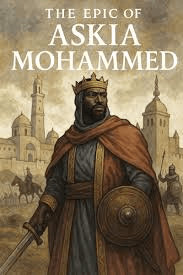
Askia Mohammed’s career reads like a symmetry-shift in political flavor space—reforming religious and administrative gauge symmetries to centralize the Songhai vacuum. His pilgrimage to Mecca and institutional reforms act as gauge transformations aligning local practice with a broader Islamic field, thus changing coupling constants across trade, scholarship, and law. These recalibrations increase the empire’s identity mass—legitimacy, scholarly prestige, and cohesive authority. The epic recounts how aligning local structures to larger cosmological symmetries reduces internal divergences (rebellion, factionalism), reinforcing state coherence. From an SLM perspective, Askia’s program is a field-theory renormalization: embed regional interaction scales into universal laws to create a stable, high-mass political particle. A state-craft Mythoplasma (N + Mγ + T) chronicling Askia’s rise and the consolidation of Songhai imperial power. Narratons (N) articulate political order; Metaphorons (Mγ) elevate the ruler’s legitimacy to cosmic scale. Temporalons (T) braid mythic origins with historical conquest. Polyphonons (P³)—griots, warriors, sages—construct a communal memory. Dissonatons (D±) arise from usurpation and struggle, but are resolved into restored symmetry as the empire stabilizes.
Shaharee Vyaas is a polyvalent cryptomathician. As such he likes to hover above the demarcation zone between Science, Art, and Religion. Where most philosophers perceive the language as the limit of our knowledge, the cryptomathic method crosses the language barriers and stipulates that the unspeakable can be expressed in paintings, music or mathematical equations.
View all posts by Shaharee

 The Maharajagar