Chapter 21; Ulysses by James Joyce.
July 15th, 2015
Description

Quotes in Ulysses;
– The mirror is the instrument of the narcist and solipsist, the broken looking glass is the instrument of the artist.
– History is my reversal omnibucal cord to humankind. It’s nothing that I suffer from, but something I keep contributing to.
– Is a ghost any more than one who faded into impalbility through dead, through absence, through change of manners?
– The growth of the son is his father’s decline his youth his father’s envy, his friend his father’s enemy.
– The intellect is worthless in the absence of love.
– What can be said of a society based upon its attitude towards procreation?
– At the termination of any allotted life, only an infinitesimal part of any person’s desires has been realized.
Ulysses (1922) was originally setup as a short story to be published in his book “Dubliners” (1914) about a young erudite teacher who had a brawl with an English constable, but was pulled out of the escalating conflict by a middle-aged Jewish man. But Joyce kept adding prose and detail to it and elaborated, and elaborated … till it ticked off at a 783 pages description of what happened to Leopold Bloom and the people he interacted with in Dublin on June 16th, 1904.
Reading this book was an exercise in strained concentration to place all the detail, comments and information of the book in a coherent perspective. It’s a sequel to a semi-biographical book “Portrait of the Artist as a Young Man”(1916) wherein the character Stephen Dedalus is the literary alter ego of James Joyce and is also an important protagonist in “Ulysses”.
The book was revolutionary at that time; as well for its mix of styles as for its content. As no writer before him, Joyce demonstrated that the content of a text defines its writing style and vice versa thus retorting to writers of that time who were lamenting about their incapacity to write to the full extend about certain subjects. Joyce resolved that by experimenting with different writing styles in one novel. So is the narrator sometimes an all knowing spirit, the thoughts of a protagonist or just absent.
Each of the eighteen chapters of the novel refers to a part of Homer’s epic “Odyssey” and its content is structured in a way to depict Bloom ( a middle aged, middle class modest man) as Ulysses and Stephen Dedalus (the young arrogant and erudite artist) as Telemachus.
Joyce reworked the ancient epic in such a way that he could lift an undistinctable average man to heroic proportions by describing the ordinary as something extraordinary.
Comments
The book is also largely encyclopedic since a lot of its protagonists discussed and thought of all kinds of subjects like literature, art, science, politics, history, and philosophy … (this list is not exhaustive).
Joyce liked to display his erudition and very often I had to put the book aside to check what he was writing about. This arrogant attitude in combination with his elusive writing style caused many prospective readers to lay down the book and never to pick it up again.
Initially the book got blacklisted in a lot of countries for its vivid and explicit descriptions of some sexual acts (ex. masturbating) and body processes (ex. farting).
After finishing “Ulysses” in 1921, Joyce would work for 17 years on what most critics call his masterpiece “Finnegan’s Wake” that was published in 1939, which has the reputation to be one of the most difficult novels ever written.
In 2015, when I made the above entry in my literary diary, I was only familiar with the first sentence of the book preceded by its last one (Bold): “A way a lone a last a loved, along the riverrun, past Eve and Adam’s, from swerve of shore to bend of bay, brings us by a commodius vicus of recirculation back to Howth Castle and Environs.” symbolizing the author’s view upon history as a cyclical process; arising from chaos, passing through theocratic, aristocratic, and democratic phases and then lapsing back into chaos . Whole dissertations have been written about this sentence alone.
To judge the increasing level of complexity of Joyce’s writing style, I give you here the opening sentence of Ulysses “Stately, plump Buck Mulligan came from the stair head, bearing a bowl of lather on which a mirror and a razor lay crossed.” Compare that to the above mentioned first/last sentence of Finnegan’s Wake and judge by yourself.
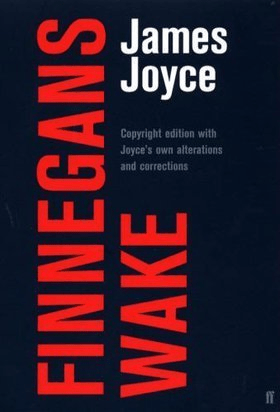
Published, November 4, 2002 by Faber & Faber, ISBN
9780571217359 (ISBN10: 0571217354)
ASIN 0571217354
Also about this book there were there mixed reactions, with some people finding enlightening and inspiration in Joyce’s prose, and others condemning it as the unreadable ravings of a lunatic.
Lately Chinese literature lovers have discovered Finnegans Wake, although the first two parts alone took eight years to translate and the translator commenting that eight words out of ten required footnotes. Not astonishing when you know that the book contains an assortment of foreign language idiosyncrasies, derived from 69 different languages, that are very often prone to different interpretations.
This last issue starts already with the title “Finnegans WAKE”: one Spanish editor translated WAKE as “La velada” (meaning vigil), another one translated it as “La estela” (trail or stele) and again another one thought it should be “La despierta” (the act of waking up or arouse).
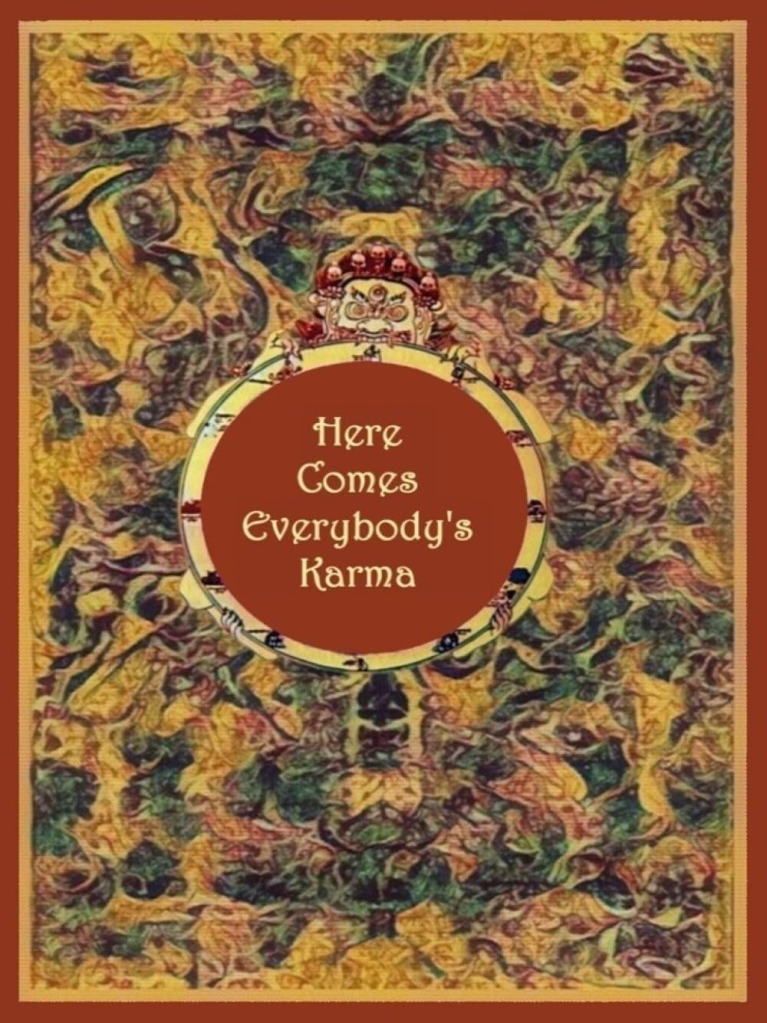
I dedicated one year of my time to translate Finnegans Wake from Joycean Gibberish into plain English (no footnotes needed) and titled it: “Here Comes Everybody’s Karma”, thus adding my own contribution to the controversy surrounding the novel’s title. I removed all the foreign language idiosyncrasies and streamlined Joyce’s prose. In case of some words or sentences with a double bottom, I settled for the one I thought to be the most appropriate into the given context (it’s a source of contention that I have with many Joyce afeccionados).
For those who set Finnegans Wake aside as an unreadable Moloch but who’re willing to give a plain English version a try, this transcription can be acquired on Amazon as a Kindle version for 9,99 euro (for free for those with an Amazon Prime subscription) or as an illustrated print edition for 40 euro. Just click on the image below to get get directed to the Amazon Kindle version.

 The Maharajagar
Thank you so much for this excellent tribute to James Joyce and his Ulysses!
LikeLike
Always welcome Luisa. Just wanted to tell you that I find Joyce a very controversial author. He’s a little bit like the exponent of Balzac (only a couple of logarithmic scales higher) and I very much suspect that he wasn´t right in his head. There is not doubt that he was very erudite, but his daughter Alicia was diagnosed with schizophrenia, and that has usually a family history (or genetical component). Who writes in heaven´s name 17 years (full time) on one book? Also the complexity of Finnegans Wake seems to increase towards the middle, just to decrease afterwards. I suspect that his diminishing eyesight has something to do with it. He had to dictate it to his secretary, what means he had to juggle it around in his head. Even for a genius than can be a challenge. Even after transcribing Finnegans Wake in plain English, and spending one year on it, I’m not really sure if it’s a work of genius or the biggest literary hoax in modern history.
LikeLiked by 1 person
Thank you so much for this valuable reflection on Joyce’s genius (or madness).
Aside from the passages you’ve suggested, making them more accessible, I’ve never read the original of Finnegans Wake, because the mere sight of those incomprehensible pages made me feel nervous.
LikeLiked by 1 person