
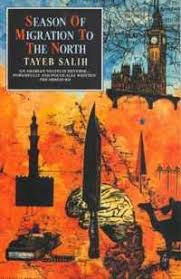
Season of Migration to the North by Tayeb Salih
March 23, 2015.
Introduction
This Sudanese, Arab written novel was published for the first time in 1966 and plays during the early years of independence from British rule (1955 till early sixties).
Summary
The story is told by an unnamed narrator, who just came back from studying seven years poetry in Great Britain (What kind of career advisor had this guy?), just to fall back upon his return into the same atavistic, tribal behavior pattern of his ancestors.
For all his erudition, he’s unable to make the simplest decision till one is forced upon him. Still the villagers regard him with awe because of his scholarly status although the elderly complain that he doesn’t use his position in the government administration to improve the access to education for the village’s children. Just one fifty years old farmer with an unknown past going by the name of Mustapha Sa’eed, who settled down five years earlier and married a local woman doesn’t seem too much impressed by his scholarly status, which of course irritates the narrator.
After the narrator lures the old man into some binge drinking, a slip of the tong reveals that Sa’eed is a scholarly trained man by himself. Onwards he agrees to tell the narrator about his past and this story will dominate the content of the book and make him the most important drama personae.
Mustapha Sa’eed was a precocious child growing up into a poor environment without father, who was sent further up the educational ladder by a succession of impressed headmasters till he wins a scholarship to study in Oxford.
Sa’eed arrives in England somewhere during the late twenties or early thirties of the 20th century and became very soon a celebrity into the left winged bohemian circles of the British bourgeoisie. Sa’eed secretly loathed this environment and their misconceptions of African culture by turning himself into the image of their parodies and reinforcing their misconceptions by inventing tales about all the clichés of oriental exoticism. At that time a lot of woman still lived into a Victorian time warp and the imposture that Sa’eed was putting down of Othello worked upon them as an irresistible aphrodisiac.
But what they got was not an Othello but a black dominator who decided to decolonize himself with his penis. After he destroyed and drove into suicide three young women, he married a white dominatrix with a dead wish.
She found fun into destroying all his works and possessions, ridiculing him at every opportunity till at the end he kills her; a fate that she apparently welcomed with pleasure. He was sentenced to seven years of prison and deported back to Sudan after finishing his sentence where he took up the life of a farmer and married a young girl.
At this point of the story, somewhere halfway the book, Sa’eed disappeared during a flood. The villagers believed he died accidently but the narrator suspected he committed suicide. Saeed’s will made him the executer of his testament and guardian of his two sons and widow, Hosna bint Mahmoud.
During the following years the narrator got an important position at the ministry of education, but kept to divide his time between Khartoum and his village, Wad Hamid. After a couple of years he learned that an elderly friend of his grandfather wanted to marry the young widow of Sa’eed, but when he consulted her about the subject she vehemently rejected it, adding that she would rather kill a new husband imposed upon her and commit suicide afterwards.
When the narrator told this to his grandfather’s friend, the old man was insulted and angry, telling him that Hosni’s father and brothers already consented to the marriage. The narrator realized that he was in love with Hosna by himself, but when a friend suggested him to marry the young widow, thus solving the dilemma, he sulked again in undecidedness and fled to Khartoum.
Upon his return to the village he learned that Hosni’s father was beating her until she consented to marry the old man of his choice. After the wedding she didn’t want to consume the marriage and shortly afterwards she stabbed her husband and herself to dead.
The narrator was inconsolable and when he heard that his friend, who’s meanwhile chief of the village, refused Hosni a funeral he got into a fitting rage who was just met with indifference (he could have avoided the whole thing to happen into the first place). Afterwards he opened Saeed’s room, which was closed since his dead and found more pictures and other memorabilia’s of Sa’eed’s time in England.
Shortly after that he decided to drown himself into the Nile, but somewhere into the middle of the stream, when he contemplated if he should live or die, for the first time into his life he made a decision; he wanted to live and started to cry for help.
Comments
The reader must imagine by himself to what purpose the narrator decided to live. To me it just sounded like that again the narrator couldn’t make up his mind; first he decided to kill himself and then, into the middle of the process, he started to contemplate if he should live or die while usually that question precedes the decision to commit suicide.
The author depicted two personages who ultimately failed to reconcile their European scholarly knowledge with their African tribal values. The first one reacted violently and turned himself into a caricature of an African man to ridicule an as oppressive perceived culture. At the end of his life, Sa’eed simply decided to ignore the knowledge he accumulated in Oxford to dedicate himself to the life of a farmer.
The narrator secretly admires the first one but is hampered by undecidedness and weak will power. Every time he tries to mimic Sa’eed; first by lusting for his widow and secondly by wanting to undergo the same fate as his hero, he wrestles with the decision till other people take it out of his hands.
At the end of the story, when he decided to live, he started also to cry for help, thus again putting the decision if he should live or die in the hands of other people.
Obviously, the narrator got saved; otherwise, there wouldn’t have been a story to tell. To paraphrase the title of this book, his mind migrated to the North while his heart remained into the South.

 The Maharajagar
Thanks a lot for sharing this interesting review!
LikeLike
My pleasure Luisa. In case that you didn’t notice, those are extracts of my literary diary from 10 years ago. As a rule I keep those to myself, but since I’m lately a little bit busy with other projects, I decided to use the notes of this literary experiment to keep my blog going.
LikeLiked by 1 person
I’m glad you did that because your articles are really interesting. 🙏🙏🙏
LikeLiked by 1 person