
The primary transcription goal of Finnegans Wake into Here Comes Everybody’s Karma (isbn 9781737783299) was to open Joyce’s Opus Magnum for a wider reading public by replacing the foreign language idiosyncrasies with an English equivalent and by streamlining Joyce’s sibylline prose.
This required me to engage with the prose of Finnegans Wake that goes beyond that of simply transcribing the text in readable English.
While the foreign language idiosyncrasies in Finnegans Wake are often open constructs that gave place to multiple interpretations, transcribing this novel into plain English required choices to be made which interpretation would fit best with my interpretation of Finnegans Wake.
I chose to interpret the novel from a personal cryptomathematical perspective by placing the novel into a contemporary context that reflects the links that can be laid between Finnegans Wake and some Asiatic philosophical tenets, quantum mechanics, and the system theory.
Finnegans Wake consists of four books that Joyce just named Book 1,2,3, and 4. In Here Comes Everybody’s Karma the books and their chapters were given titles, thus giving some structure to an otherwise labyrinthic tale.
One cannot overlook the thematic resonance of reincarnation in Finnegans Wake, a pivotal tenet within various Asiatic spiritual traditions, which mirrors the cyclical rhythm of time and being explored within the depths of Joyce’s labyrinthine prose. By artfully intertwining elements of Eastern philosophical wisdom, the enigmatic principles of quantum mechanics, the interconnectedness underscored by system theory, and the boundless realm of literature, “Finnegans Wake” transcends conventional boundaries of reality and plunges readers into an enthralling exploration of the interconnected tapestry of ideas that collectively shape our understanding of the vast universe in which we dwell.
The interconnectedness of characters and events within James Joyce’s monumental work, “Finnegans Wake,” serves as a profound reflection upon the concept of karma, where individual actions reverberate throughout the narrative with far-reaching consequences. This interplay reflects a cosmic dance of cause and effect, wherein characters are symbolically reborn, embodying the perpetual cycle of existence central to both profound Eastern Philosophy and the tapestry of the novel itself. The overarching cyclical motif within the narrative echoes the transient nature of personal identity and the ceaseless evolution of consciousness, echoing the timeless Eastern concept of samsara, the eternal wheel of life, death, and rebirth.
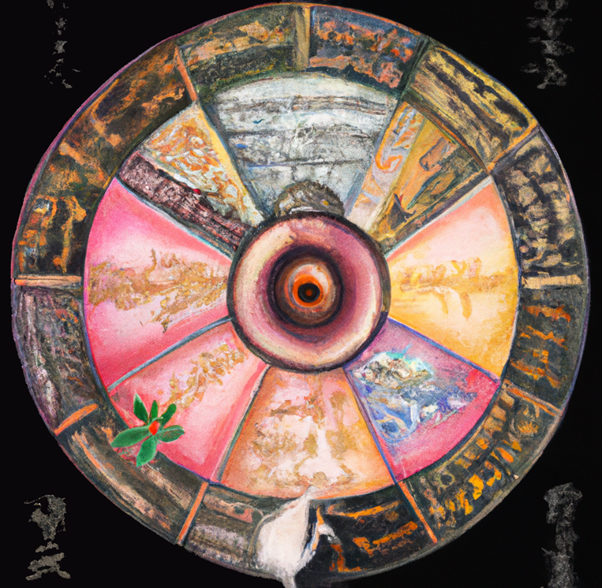
Quantum mechanics, on the other hand, challenges our traditional notions of reality by suggesting that particles can exist in multiple states simultaneously and that observation plays a crucial role in determining outcomes. It introduces a fascinating perspective on the multiple realities and possibilities that exist simultaneously, mirroring the fragmented and non-linear structure of Finnegans Wake. The uncertainty principle, entanglement, and superposition of states resonate with the novel’s intricate narrative layers and the characters’ interconnected stories, suggesting a fluid and dynamic interpretation of reality. This idea coincides with the themes of uncertainty and interconnectedness in “Finnegans Wake,” where characters and events are intertwined in a complex web of relationships that defy conventional linear narratives.

The novel’s storytelling architecture, replete with intricate systems and interwoven narratives, reflects a holistic interconnectedness strikingly reminiscent of the fundamental principles proposed within system theory.
Take for example the fractal complexity of the novel. Fractals are mathematical shapes that have been used to model patterns that repeat on many different scales. Looking at a coastline map, we cannot tell the scale; a fractal coast looks similar at all scales. As the map is enlarged, more details appear, but the general character of the coast remains unchanged over several orders of magnitude. This self-similarity is typical of fractals
Short sentences can ease comprehension but can become tedious. Longer more complex sentences can be more expressive but also more demanding. Writers intuitively vary sentence length for stylistic and aesthetic ends. The distribution of sentence lengths can reveal hidden aspects of literary works. Mathematical tools like spectrum analysis, wavelet decomposition and multifractals can be used to analyze sentence length variability.
The structure of Finnegans Wake was virtually indistinguishable from a purely mathematical fractal. Of course, the fractality of a literary text can never match the ideal: a mathematical fractal can be magnified interminably while the number of sentences in a book is finite.
The spread of fractal dimension provides an index of complexity. The complexity index of Finnegans Wake, with its exploration of the mental labyrinths of the dream state, was 0,74, while that of Here Comes Everybody’s Karma approaches that of 0.63 because some of the longer sentences in Finnegans Wake have been broken up into smaller ones to enhance its readability.
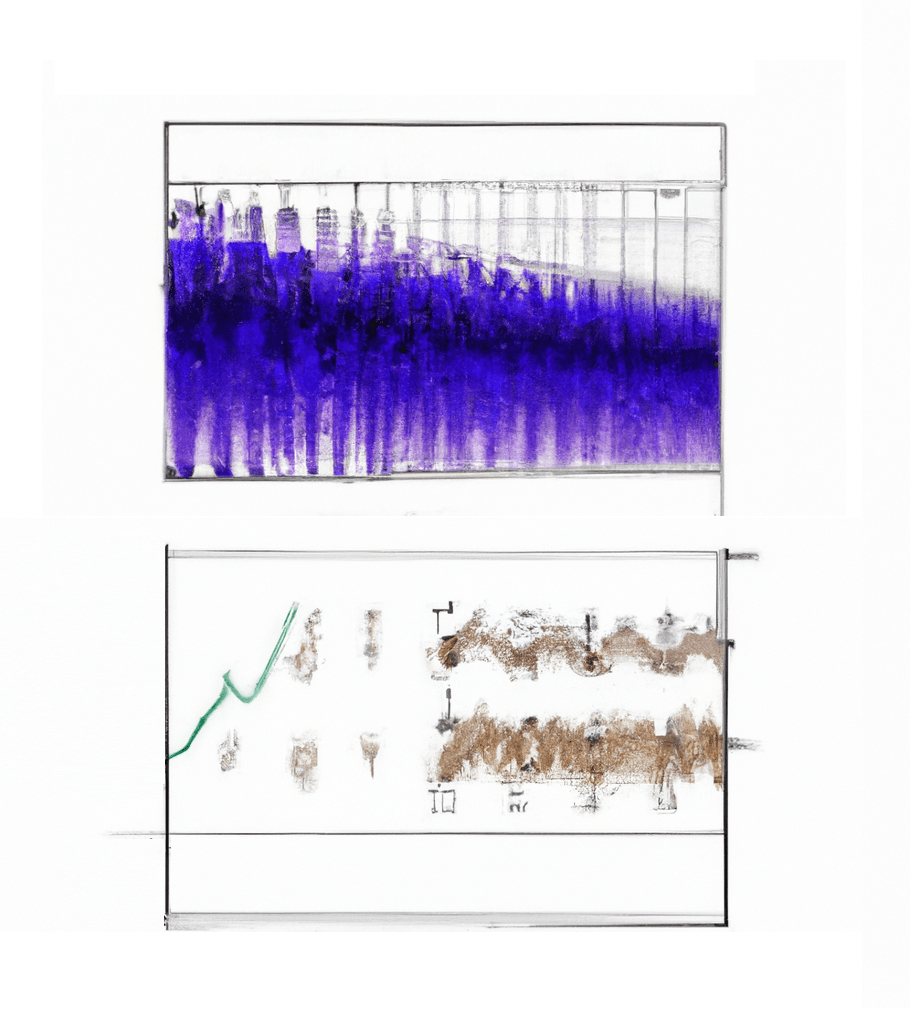
This marriage of form and content underscores the inherent complexity and interdependence that define not only the fictional world within the novel but also the broader cosmic landscape that we inhabit. By engaging with themes of karma, dharma, reincarnation, quantum mechanics, and system theory, Joyce’s magnum opus challenges us to reconsider our understanding of reality, consciousness, and the fundamental nature of the universe. As HCEK navigates the labyrinthine depths of “Finnegans Wake,” we are invited to contemplate the eternal dance of creation and destruction, the fluidity of identity, and the enduring quest for meaning in a universe governed by both order and chaos.
References:
Joyce, J. (1939). Finnegans Wake. Faber and Faber.
Bohr, N. (1934). Atomic theory and the description of nature. Nature, 133, 793-794.
Bertalanffy, L. V. (1968). General System Theory: Foundations, Development, Applications. George Braziller.
Capra, F. (2010). The Tao of Physics: An Exploration of the Parallels between Modern Physics and Eastern Mysticism. Shambhala Publications.
Pingta Ku (2021) “The abnihilisation of the etym”: Finnegans Wake’s Entanglement in Quantum Ideality.” Concentric: Literary and Cultural Studies, March 2021: 129-148 DOI: 10.6240/concentric.lit.202103_47(1).0007
Smith, J. (2008). The essence of Eastern philosophy. New York: Routledge.
Stanisław Drozdz, et al, 2016: Quantifying origin and character of long-range correlations in narrative texts. Info. Sci. 331, 32-44.
SZCZEPANIK LIDIA “Sandhyas Sandhyas Sandhyas!” Indian Thought in Finnegans Wake, Studia Litteraria Universitatis Iagellonicae Cracoviensis 9 (2014), z. 4, s. 303–310 doi:10.4467/20843933ST.14.025.3072

 The Maharajagar
I greatly appreciate not only the work you have done but also these reflections. I found them really valuable and interesting
LikeLiked by 1 person
Thank you Luisa. It’s still an ongoing project.
LikeLiked by 1 person
My pleasure! 🙏🌹
LikeLiked by 1 person