
This undertaking is a multidisciplinary project bringing together music, visual arts, literature, and science, centering them around a vision that has been developed in the manifest “The All is an Egg”. The manifest is mainly an adjusted continuation of a vision Salvador Dali laid out in his Mystical Manifesto, that was a hybrid combination of nuclear physics and Catholic doctrine.
“The All is an Egg” is an essay that rests upon an attempt to offer a unifying metaphysical frame for the fragmented human knowledge. The concept is founded upon the idea of how the cyclical nature of a multitude of phenomena mirrors circulatory biological patterns.
Connecting art, science, and religion, with the metaphor of the egg foisted onto it, is a transformative work, and a profound invitation to reflect.


From there an artistic approach emerged, inspired by Frank Zappa’s Project/Object concept for his work in various mediums. Each of the displayed projects (in whatever realm) are part of a larger object, that is defined as mystic cyclical synthetism. As such, the art show is multifaceted in its effort to bring forward a new perspective upon the nature and significance of human civilization.
My visual art develops along a stylistic concept that I call “surpressionism”. It is an exciting new art style that merges the fluid brushstrokes and vibrant colors of impressionism with the otherworldly and dreamlike qualities of surrealism. This unique blend creates a sense of movement and depth in the painted scene, encouraging the viewer’s imagination to take flight.
This style evokes emotions through suggestion, rather than realism. It’s an art form that seeks to capture the spirit and essence of its subject. Surpressionism is a fresh and unique concept, and it offers endless possibilities for artists looking to push the boundaries of traditional art styles.

The theme of the opera that forms part of this project, revolves around a comparison between the cyclic nature of human civilization and that of our solar system. The music is derived from a sonorization of the electromagnetic waves emitted by the main celestial bodies that form our solar system. These chaotic sounds were then processed through a synclavier in order to produce some melodies that make sense to the human ear. In these compositions, every sound has a value, and every action is part of the universal diapason, a colossal vibration that makes energy rather than reflecting it.
The cover of this album is named after the theme that inspired this art show (A Cosmology of Civilization).
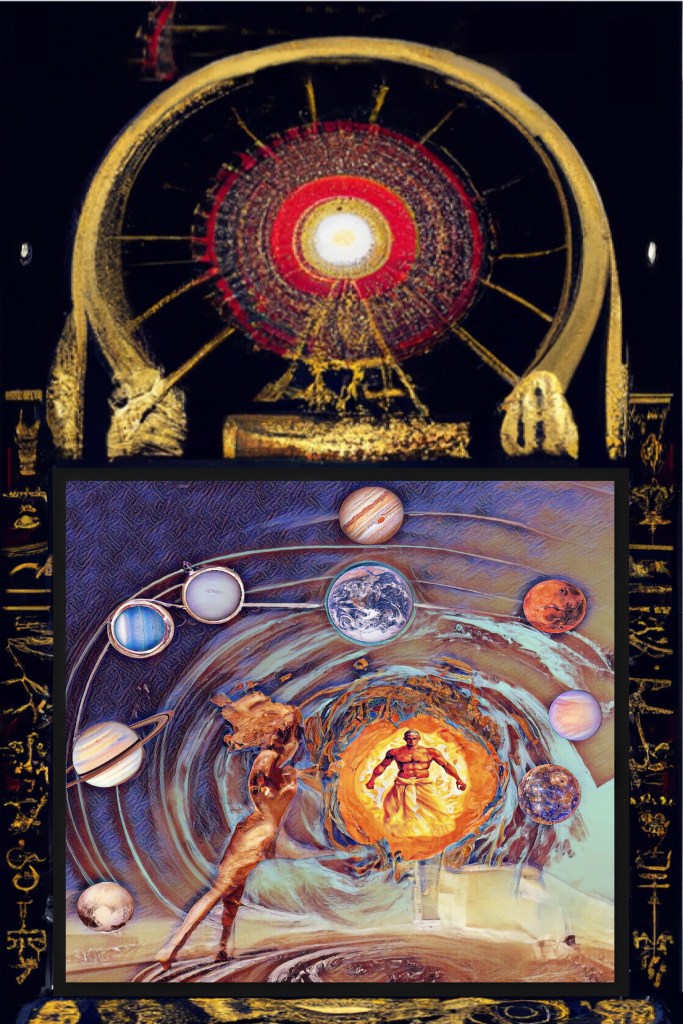
W 50 x H 75 x D 0.5 cm
(19.7 x 29.5 x 0.4 in.) by Shaharee Vyaas (2023).

The first literary facet of this art project consists of a literary art experiment that merges the most beautiful book in English literature, the Kelmscott-Chaucer, with its most enigmatic one, Finnegans Wake. Its main subject is the cyclical nature of time.

A more recent addition is a saga that is called “The Maharajagar.” Rooted in historical fantasy and inspired by the structure of the Mahabharata, the novel traces the paths of a diverse ensemble of characters bound together by fate, ancient forces, and a mysterious cosmic bond called the Qi’tet.
The narrative begins with the collision of five strangers in North America at the dawn of World War I. Each hails from a different cultural and spiritual tradition—Taoist mysticism, Voodoo, Indigenous shamanism, South Asian martial philosophy, and European rationalism. Together, they form a brotherhood that unlocks latent powers buried within human memory and genetic myth. Drawn into a web of occult conspiracies, forgotten shrines, and supernatural allegiances, they soon discover their bond transcends time and may be tied to the fate of humanity itself.
As the story unfolds, The Maharajagar travels across continents and dimensions—from war-torn cities and subterranean libraries to floating islands and labyrinthine dreamscapes. Along the way, the protagonists encounter ancient beings, cryptic prophecies, and symbolic entities that challenge their identities, loyalties, and very understanding of reality.
At the heart of the tale is a question: what is the cost of power when memory itself becomes a weapon? Each member of the Qi’tet must face personal trials that blur the lines between history and mythology, self and shadow, destiny and choice. Their journey demands sacrifice—not only of comfort and illusion, but of what they hold most dear.
The novel explores major metaphysical themes: synchronicity, the idea that meaningful coincidences are shaping evolution; the Longer Now, a view of history as a living continuum; and the nature of reality as a dynamic projection shaped by memory, intention, and language. Woven through it all is the interplay between belief systems—Eastern and Western philosophies, Indigenous cosmologies, Afro-Caribbean spiritualities—without reducing any to cliché or caricature.
The tone of The Maharajagar is at times dark, poetic, surreal, and humorous. Its chapters unfold like mythic episodes, resonating with archetypes while maintaining deep psychological realism. The world it builds is not merely an alternate history—it is a reflection of our own, magnified through the lens of dreams, trauma, and the hidden forces that bind people across cultures and generations.
Ultimately, The Maharajagar is about remembrance: of lives lost, stories buried, and truths suppressed. It is a story of unlikely kinship, of resistance through compassion, and of becoming more than what history would allow. While steeped in mythology and fantasy, it never strays far from the human heart.
It is not a tale of conquest or domination, but of balance—and the price of maintaining it.

My biggest “aha-moment” occurred when I realized that no artist is an island, and that most artists just pick up a thread where other artists had to drop it. It is humbling to consider that most of what we do, has very often already been done before, and that our proud “inspirations” are just updated art history.
CATALOG
 The Maharajagar