The Daoist text describes a low-action algorithm: minimize forcings, align with natural flows, and the system self-organizes. Its advice acts like a dissipative operator removing excess energy and allowing emergent order. In SLM terms, the Dao is a prescription for constructing a nonintervening Higgs field: less deliberate action produces more sustainable identity mass by aligning … Continue reading 10. Tao Te Ching (Dao De Jing) — Laozi (China)
9. Analects — Confucius (China)
The Analects present a prescriptive dynamics for social stability. Rituals and hierarchical roles are selection rules: perform them correctly and social coherence emerges. The Analects thus provide precise Lagrangian terms that penalize deviance and reward conformity, producing low-entropy social arrangements.A lean Realiton (N + D±) stabilized through ethical clarity. Dissonatons (D±) emerge in the friction … Continue reading 9. Analects — Confucius (China)

8. The Odyssey — Homer
In the Standard Literary Model, The Odyssey behaves like a baryon: a bound state of wanderer, memory, and fate locked into an oscillatory pattern by the strong force of home. Odysseus is a quark of identity that refuses confinement yet can never fully escape it; every island he encounters is another local minimum in the … Continue reading 8. The Odyssey — Homer
7. The Iliad — Homer
The Iliad is a collision event—two massive bodies (Achilles’ rage and Troy’s stubborn dignity) smashing together in a storm of hadronic debris. The poem behaves like a high-energy scattering experiment in which honor, mortality, and divine interference are particles exchanging momentum with catastrophic results. Achilles is effectively a top quark: heavier than the narrative can … Continue reading 7. The Iliad — Homer
6. The Upanishads (India)
The Upanishads function as renormalization techniques for inner life. They propose methods for subtracting superficial divergences—ego, desire—to reveal a more fundamental field of Brahman. Practices they recommend (meditation, ethical discipline) are operators reducing self-interaction terms and allowing consciousness to experience unified modes. In SLM, the Upanishads describe a path to lower-energy coherence: when the individual … Continue reading 6. The Upanishads (India)

5. The Vedas (India)
The Vedas operate like foundational field equations: hymns that set cosmological symmetries, ritual operators, and priestly mediators that maintain the sacrificial vacuum. Their liturgies are bosonic actions transmitting sacred charge between human and cosmic realms. The sacrificial system establishes selection rules that regulate social stratification and perform energy transfers (offerings), preserving cosmic order (ṛta). In … Continue reading 5. The Vedas (India)
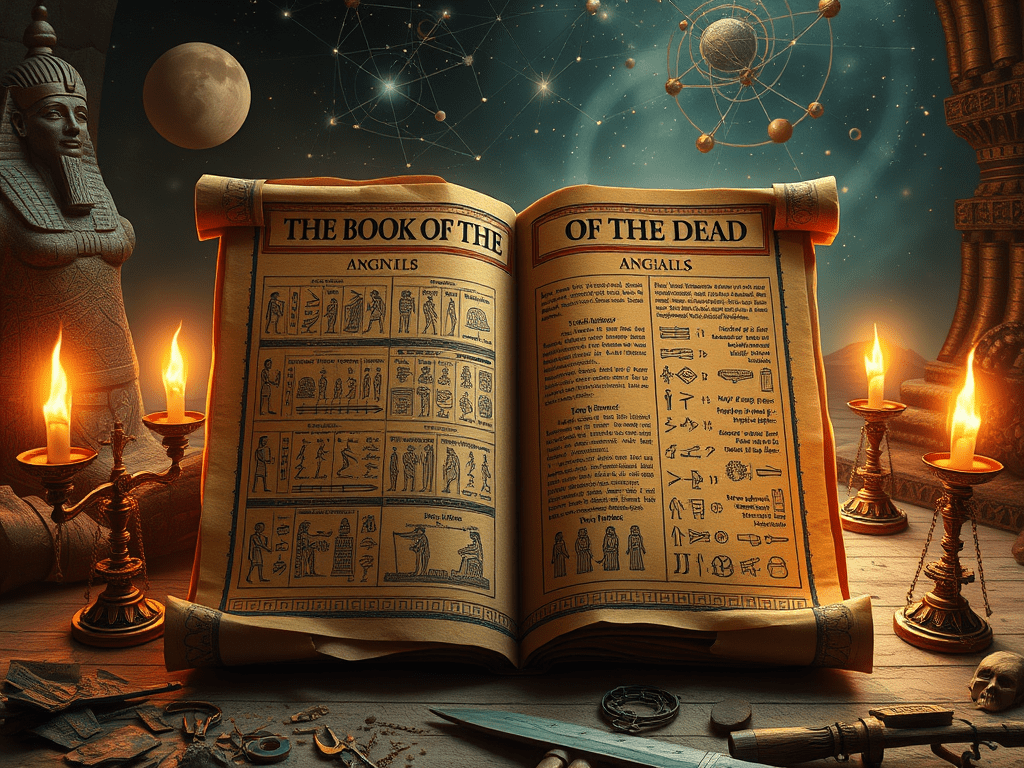
4. The Book of the Dead (Ancient Egypt)
The Book of the Dead functions as a manual for traversing the post-mortem vacuum: a set of boundary conditions and selection rules for the soul-field’s passage through the underworld. Each spell is a local operator altering the probability amplitude of safe passage—preserving identity-mass against decay. The heart-weighing scene is a literal measurement device: the scales … Continue reading 4. The Book of the Dead (Ancient Egypt)
3. The Instruction of Ptahhotep (Ancient Egypt)
The Instruction of Ptahhotep is a low-energy effective theory: a compact Lagrangian of social rules that regulate interaction in an Egyptian legal-gauge. Its aphorisms act like conserved currents—protocols that minimize conflict and stabilize the civic vacuum. Each proverb functions as a mediated interaction (gauge boson) transmitting authority from elder to younger generations. The "mass" these … Continue reading 3. The Instruction of Ptahhotep (Ancient Egypt)

2. The Tale of Sinuhe (Ancient Egypt)
The Tale of Sinuhe reads as an early field-theory experiment in identity and exile. Sinuhe is a fermionic excitation displaced from the Egyptian vacuum by war and rumor; his wandering through Levantine courts resembles a particle propagating through different media with varying coupling constants—hospitality, dishonor, foreign custom. Egypt itself functions as a dominant Higgs-like background … Continue reading 2. The Tale of Sinuhe (Ancient Egypt)

1. The Epic of Gilgamesh (Mesopotamia)
Gilgamesh is a prototypical heavy excitation resisting mortality. Enkidu’s entrance turns the two into a bound pair, like a baryonic composite stabilized by intense mutual coupling. Enkidu’s death is a perturbation that shifts Gilgamesh’s vacuum: the hero gains existential mass—grief, wisdom—forcing a search for permanence (immortality) that results in a renormalized appreciation of the communal … Continue reading 1. The Epic of Gilgamesh (Mesopotamia)
Reading the canon of world literature
Chapter 21; Ulysses by James Joyce.July 15th, 2015Description Quotes in Ulysses;- The mirror is the instrument of the narcist and solipsist, the broken looking glass is the instrument of the artist.- History is my reversal omnibucal cord to humankind. It’s nothing that I suffer from, but something I keep contributing to.- Is a ghost any … Continue reading Reading the canon of world literature
Reading the canon of World Literature
Chapter 20; Father Goriot by Honore de Balzac.July 2nd, 2015Summary Most of the action is centered around a boarding house called Maison Vauquer, ran by a widow, Mme. Vauquer. The story relates mostly to the interactions between Jean-Joachim Goriot, a retired vermicelli maker who bankrupted himself to give his daughters a better future; a secretive … Continue reading Reading the canon of World Literature
Reading the Canon of World Literature
Chapter 19; The Adventures of Huckleberry Finn by Mark TwainJune 25th, 2015This book counts 366 pages and was first published in 1884 in the UK and a year later in the US. It played mainly along the Mississippi River into a pre-civil war society that already 20 years ceased to exist by the time the … Continue reading Reading the Canon of World Literature
A Synopsis of US literature: Science Fiction
An answer to Pynchon’s question "What comes now?" is heavily explored by an often-neglected facet of US literature; science fiction, a genre that contemplates possible futures. Because science fiction spans the spectrum from the plausible to the fanciful, its relationship with science has been both nurturing and contentious. HG Wells who, by most critics, is … Continue reading A Synopsis of US literature: Science Fiction
A Synopsis of US literature: 1960 – 1980.
The 1960s, a period often called the "Sixties" or the "Swinging Sixties," were characterized by significant social, political, and cultural shifts. Key themes included the fight for civil rights, the Vietnam War, the rise of the counterculture, the sexual revolution, and the beginning of the feminist movement. The decade witnessed both optimism and upheaval, with … Continue reading A Synopsis of US literature: 1960 – 1980.
Synopsis of US literature: 1930 – 1960
In the early thirties, the first reaction to the depression was a literature of social protest. The failure of the American dream became the main theme in Jewish-American literature. The novel “Call it Sleep" mixes Marxism and Freudian theory, Jewish mythology and a stream of consciousness writing style. Farrell writes more about spiritual poverty then … Continue reading Synopsis of US literature: 1930 – 1960
A Synopsis of Us Literature: 1890 -1910.
In the 1890's, many realists became naturalists, a term created by Emile Zola. For them realism was an ideology and the novel had the power to become a political weapon. Crane had the view that life and death are determined by fate. He wrote about a man who said to the Universe "Sir, I exist! … Continue reading A Synopsis of Us Literature: 1890 -1910.
A sinsopsis of US literature: 1854 – 1890
European observers, who take a close look at the characteristics that they qualify as typical for white Americans, discover soon that they were originally attributes of the American Indian. The liberation from a social hierarchy and the idea that “all men are born equal” is also an American Indigenous invention that crossed the Atlantic Ocean … Continue reading A sinsopsis of US literature: 1854 – 1890
A sinopsis of US literature: 1810 – 1854.
1810 - 1840 is known as the Knickerbockers’ Era of American literature. The name comes from "A History of New York" by Dietrich Knickerbocker, a pseudonym of Washington Irving. It was a humorous rather than a serious history of the city. He invented many of the events and legends he wrote about in the book. … Continue reading A sinopsis of US literature: 1810 – 1854.
A Brief Sinopsis of US literature: 1735 – 1810.
In the early days of independence, American novels served a useful purpose. They used realistic details to describe the reality of American life. But when some of the good American literature started to arise above the time and place where they were written; these works became universal. The oldest examples are the sketches and observations … Continue reading A Brief Sinopsis of US literature: 1735 – 1810.
 The Maharajagar