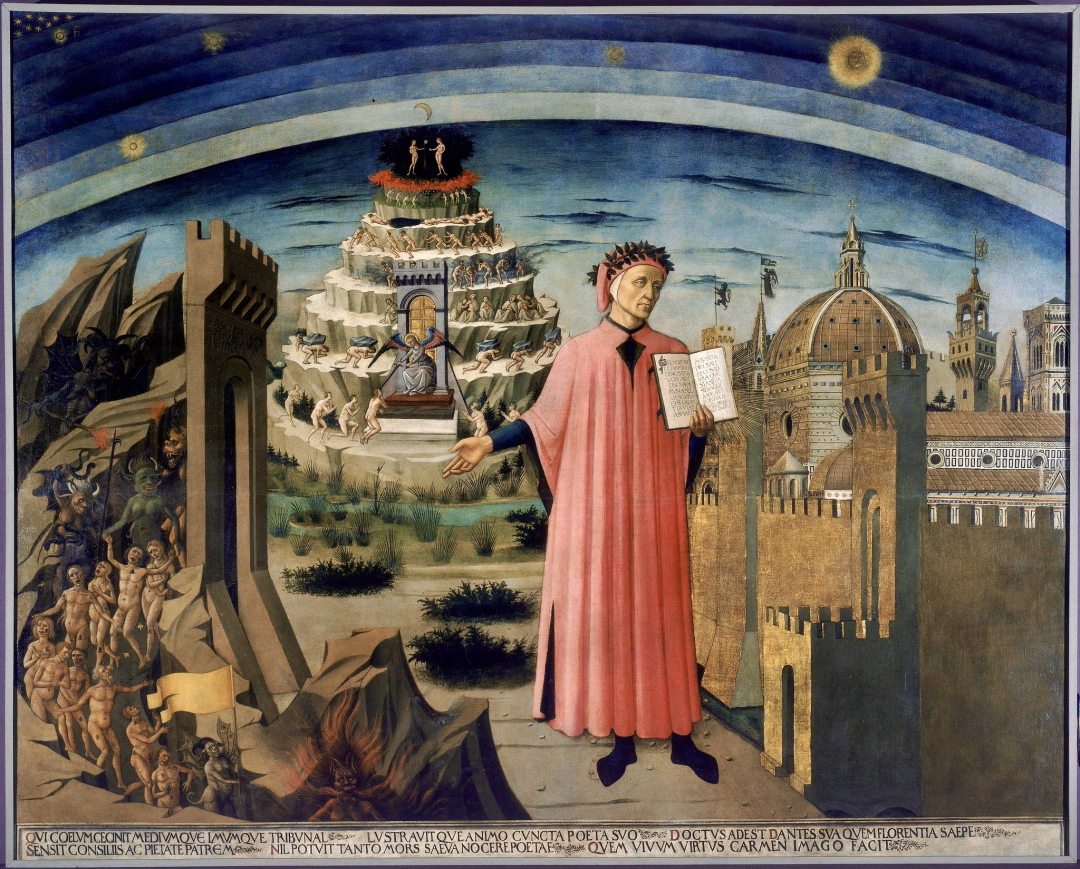
Paradiso is Dante’s foray into pure theoretical physics: a universe of crystalline spheres, perfect symmetries, and luminous matter. Here, souls are not punished or purified but exist in states of increasing vibrational bliss, aligned with divine frequency. Beatrice acts as an ultra-high-energy mediator, guiding Dante through realms where distinctions blur—light becomes intellect, motion becomes joy, time dissolves into eternity. The higher he ascends, the more abstract the interactions: angels behave like massless bosons, saints like resonance peaks in a cosmic harmony. The Empyrean is a final unification, a realm where the Great Equation resolves into a single, dazzling truth. In this model, God is not a being but the fundamental symmetry from which all particles—and all loves—derive. The final vision is indescribable precisely because it reaches beyond human measurement, into the physics of pure being.
Dante designs a cosmos that functions like an idealized Standard Model of the soul, each realm corresponding to a different sector of metaphysical symmetry. Hell is the domain of confinement, where sins behave like quarks trapped in potential wells of their own making. Every punishment is a stable resonance state—eternal, oscillatory, perfectly matched to the moral charge of its occupant. Purgatory is the realm of renormalization: impurities are gradually subtracted, infinities tamed, divergences regulated. Each terrace recalibrates the pilgrim’s internal parameters, preparing him for the high-energy clarity of Paradise. Beatrice functions as a photon—pure light, massless, guiding Dante through increasingly subtle transformations as he ascends toward the empyrean. God, envisioned as three luminous circles, is the ultimate unbroken symmetry, the grand unifying field where distinctions vanish and all particles become modes of the same vibration. The poem is less theology than theoretical physics of the medieval mind: an attempt to map the architecture of moral energy, quantizing virtue and vice into discrete, observable states.
Paradiso becomes a luminous Mythoplasma (N + Mγ + T) powered by Metaphorons (Mγ) that translate metaphysical truths into perceivable radiance. Temporalons (T) stretch perception into a non-linear eternity where past, present, and divine foreknowledge coexist.
Polyphonons (P³) sing through the spheres, generating a harmonic cosmology. Here, Dissonatons (D±) nearly vanish—conflict is transmuted into alignment. Silention (S⁰) marks the limits of human comprehension, defining the borders at which the intellect dissolves into the divine.
The poem ends in perfect symmetry: the narrative self merges with universal order.
Fundamental Particles
| Particle | Symbol | Function |
| Narraton | N | The basic storytelling particle. |
| Metaphoron | Mγ | The carrier of imagery; analogous to a photon. |
| Dissonaton | D± | Conflict, rupture, contradiction. |
| Silention | S⁰ | The unsaid, the erased. Appears only via absence. |
| Polyphonon | P³ | Multi-voiced narration; binds communities. |
| Temporalon | T | Manipulates chronology. |
Composite Particles
(Produced when fundamental particles bind.)
| Composite | Composition | Literary Equivalent |
| Mythoplasma | N + Mγ + T | Myth, epic cycles, cosmologies. |
| Realiton | N + D± | Realist narrative, social conflict. |
| Memoirion | N + S⁰ + T | Memory narrative, trauma narrative. |
| Fictionon | N + Mγ | The creative continuum. |
| Critical Gluon | P³ + D± | The force binding literary traditions. |
| Kindle eBook publishing Submitted on November 19, 2025 | $3.00 USDView on Amazon ASIN: B0G2YTJK5Y |
| Paperback Live Submitted on November 20, 2025 | $9.99 USDView on Amazon ASIN: B0G31YM7GR |

 The Maharajagar