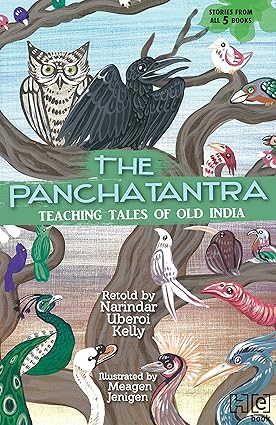
As in Kalila wa Dimna, the Panchatantra’s animal fables are pedagogical operators used to test governance and prudence. across many parameter spaces. Each tale is a controlled interaction that demonstrates consequences of certain couplings—greed, cunning, laziness—allowing listeners to update their behavioral priors experimentally. Its high transferability across cultures indicates robust eigenvalues in the cultural mixing matrix: its lessons survive translation because they address universal interaction dynamics between agents. The Panchatantra is a Fictionon (N + Mγ) enriched by the nested-structure dynamics of Mythoplasma. Animal fables use Metaphoron (Mγ) as their fundamental boson: animals embody kings, ministers, and human traits, transporting political and ethical lessons. Narraton organizes the frame story of a tutor teaching princes, within which countless embedded tales create a fractal narrative field. Polyphonon (P³) operates through multiple speakers—animals, narrators, inner narrators—creating layered voices. Temporalon (T) manipulates narrative levels, moving freely between the frame and inset stories, generating recursive moral knowledge. The result is a didactic narrative engine in which wisdom spreads through playful transformations.
Shaharee Vyaas is a polyvalent cryptomathician. As such he likes to hover above the demarcation zone between Science, Art, and Religion. Where most philosophers perceive the language as the limit of our knowledge, the cryptomathic method crosses the language barriers and stipulates that the unspeakable can be expressed in paintings, music or mathematical equations.
View all posts by Shaharee

 The Maharajagar