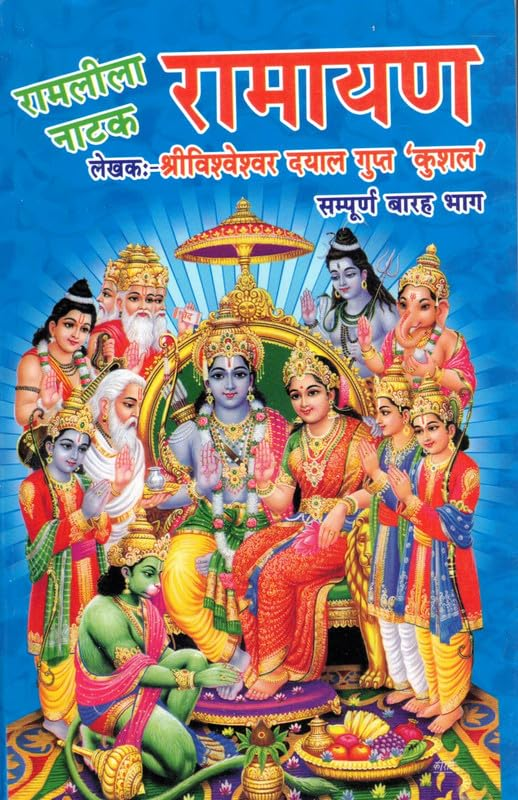
The Ramayana frames idealized role-model particles (Rama, Sita) whose conduct establishes normative selection rules for kingly, familial, and cosmic behavior. Rama’s exile and return are state transitions that test the stability of social vacua—upholding dharma under pressure resets expectations for governance and virtue. Sita’s trials probe the strength of social detectors (public scorn, legal boundaries) and highlight how reputation functions as measurable social mass. The epic’s narrative mediators—sages, divine messengers—alter couplings by issuing decrees, reshaping human decisions. In SLM terms, the Ramayana prescribes how to maintain societal coherence by modeling idealized couplings among duty, love, and power.
As an epic cosmology, the Ramayana is structured through Narraton as an ordered heroic arc, but powered by Metaphoron—flying chariots, divine weapons, monkey armies—acting as bosonic carriers binding the narrative universe. Mythoplasma dominates, blending N + Mγ + T into a vast cosmological cycle linking dharma, kingship, and cosmic order. Dissonaton (D±) punctuates the text through exile, abduction, and moral conflict, functioning as the symmetry-breaking force that propels plot and tests virtue. Polyphonon (P³) arises from multiple kingdoms and species whose voices and motives shape the epic’s moral topology. Temporalon (T) modulates pace—years of exile compress into moments; cosmic past and future flicker through prophetic glimpses. The Ramayana’s literary field thus fuses divine myth, human duty, and ethical paradox into a coherent high-energy epic system.
Fundamental Particles
| Particle | Symbol | Function |
| Narraton | N | The basic storytelling particle. |
| Metaphoron | Mγ | The carrier of imagery; analogous to a photon. |
| Dissonaton | D± | Conflict, rupture, contradiction. |
| Silention | S⁰ | The unsaid, the erased. Appears only via absence. |
| Polyphonon | P³ | Multi-voiced narration; binds communities. |
| Temporalon | T | Manipulates chronology. |
Composite Particles
(Produced when fundamental particles bind.)
| Composite | Composition | Literary Equivalent |
| Mythoplasma | N + Mγ + T | Myth, epic cycles, cosmologies. |
| Realiton | N + D± | Realist narrative, social conflict. |
| Memoirion | N + S⁰ + T | Memory narrative, trauma narrative. |
| Fictionon | N + Mγ | The creative continuum. |
| Critical Gluon | P³ + D± | The force binding literary traditions. |
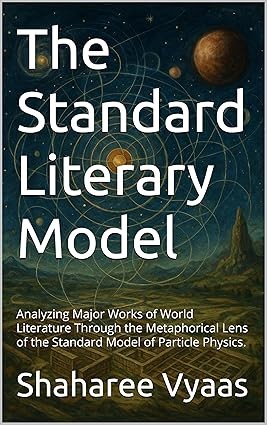
| Kindle eBook publishing Submitted on November 19, 2025 | $3.00 USDView on Amazon ASIN: B0G2YTJK5Y |
| Paperback Live Submitted on November 20, 2025 | $9.99 USDView on Amazon ASIN: B0G31YM7GR |

 The Maharajagar