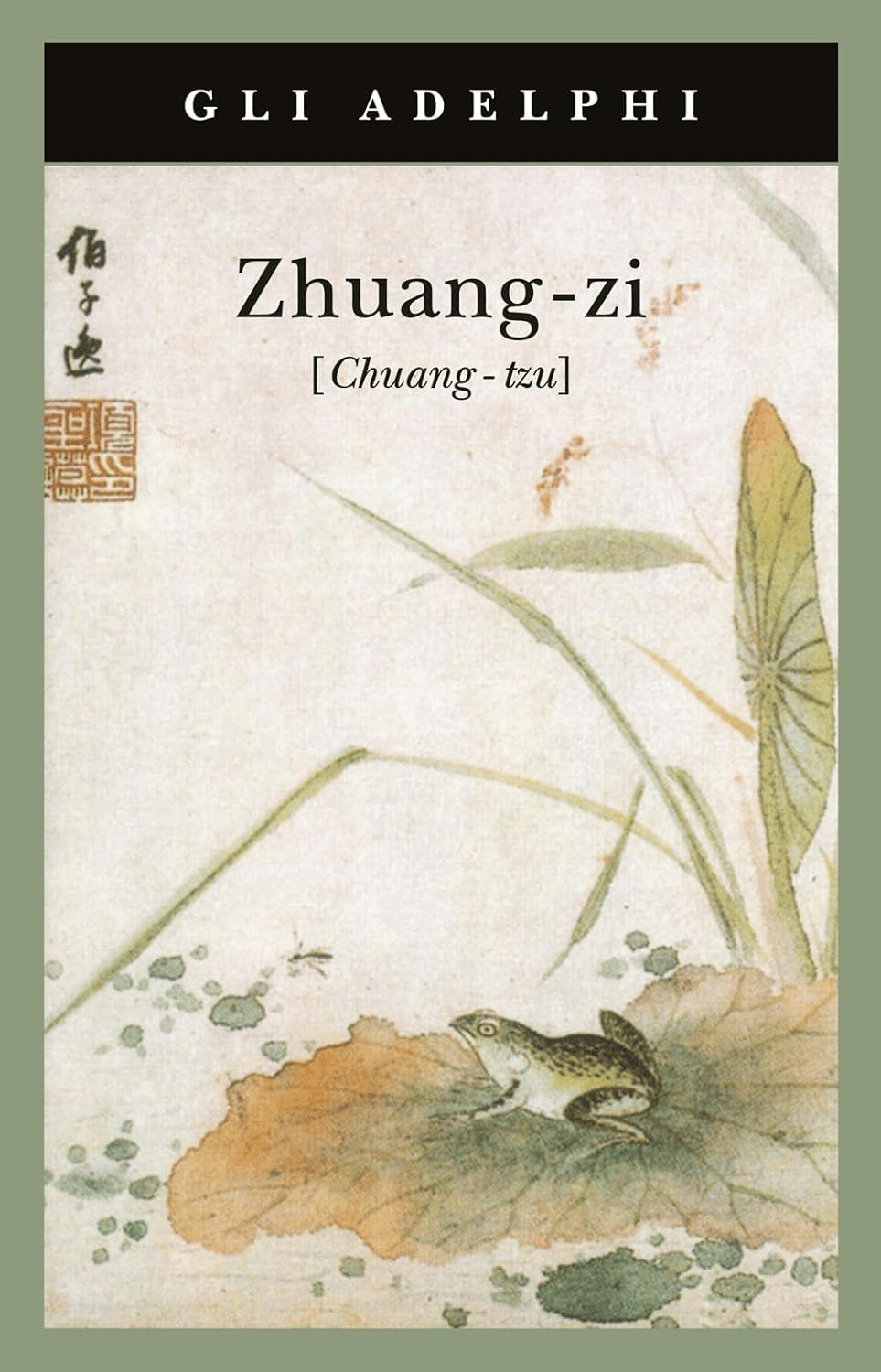
Zhuangzi destabilizes fixed identity-mass by questioning categories and promoting adaptive superpositions. His parables encourage flexible couplings, suggesting that rigid potentials lead to suffering; in SLM, he prescribes dynamic renormalization—allowing states to be context-dependent rather than fixed invariants.
The Zhuangzi operates as a philosophical Mythoplasma, intertwining N + Mγ + T to create drifting parables whose logic is fluid, humorous, and destabilizing. Metaphoron governs the text: butterflies, fish, winds, and gourds become vehicles of epistemic play, scattering imagery like bosonic carriers of insight. Silention (S⁰) appears in deliberate gaps—what is not stated is often more important than what is articulated, mirroring Daoist negative space. Temporalon (T) dissolves linear time: sages leap centuries, transformations occur in an instant, and chronology behaves like a free field without constraints. P³ Polyphonon emerges as shifting personas—masters, tricksters, spirits—producing a multivoiced philosophical field. Dissonaton (D±) intermittently fractures assumptions, breaking rigid distinctions between self/other, real/dream, human/nature. The resulting literary particle-matrix creates a radical epistemology, one where meaning is an emergent fluctuation rather than a fixed property.
Fundamental Particles
| Particle | Symbol | Function |
| Narraton | N | The basic storytelling particle. |
| Metaphoron | Mγ | The carrier of imagery; analogous to a photon. |
| Dissonaton | D± | Conflict, rupture, contradiction. |
| Silention | S⁰ | The unsaid, the erased. Appears only via absence. |
| Polyphonon | P³ | Multi-voiced narration; binds communities. |
| Temporalon | T | Manipulates chronology. |
Composite Particles
(Produced when fundamental particles bind.)
| Composite | Composition | Literary Equivalent |
| Mythoplasma | N + Mγ + T | Myth, epic cycles, cosmologies. |
| Realiton | N + D± | Realist narrative, social conflict. |
| Memoirion | N + S⁰ + T | Memory narrative, trauma narrative. |
| Fictionon | N + Mγ | The creative continuum. |
| Critical Gluon | P³ + D± | The force binding literary traditions. |
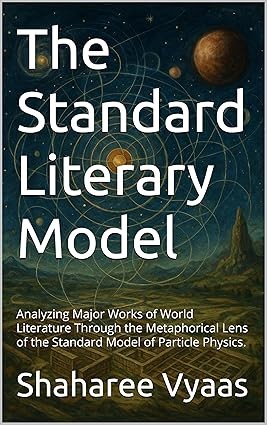
| Kindle eBook publishing Submitted on November 19, 2025 | $3.00 USDView on Amazon ASIN: B0G2YTJK5Y |
| Paperback Live Submitted on November 20, 2025 | $9.99 USDView on Amazon ASIN: B0G31YM7GR |

 The Maharajagar