
In the Standard Literary Model, The Odyssey behaves like a baryon: a bound state of wanderer, memory, and fate locked into an oscillatory pattern by the strong force of home. Odysseus is a quark of identity that refuses confinement yet can never fully escape it; every island he encounters is another local minimum in the potential landscape, a false vacuum promising rest but offering only metastability. Athena’s interventions function like gauge bosons—messengers of symmetry correction—nudging the hero back toward the broken-symmetry phase we call Ithaca. The sea itself is a fluctuating quantum field, collapsing only temporarily into monsters or temptations depending on the observer’s moral charge. Penelope, patiently weaving and unweaving, becomes the Higgs field of the narrative: the medium that grants mass to Odysseus’ longing, the background field that ensures his wandering has weight. Without her constant vacuum expectation value, he would diffuse into mythic noise. The poem endures because its physics mirrors our own: no trajectory is straight, no exile permanent, and every return requires a symmetry to be broken and repaired.
Powered by Temporalon (T)—a wandering, looping journey — the Odyssey blends Fictionon (N + Mγ) with Mythoplasma. Metaphorons (Mγ) animate monsters, islands, disguises. Dissonatons (D±) appear in identity puzzles, loyalty tests, and Odysseus’s own contradictions. Silention (S⁰) shapes Penelope’s quiet strategies and Odysseus’s unspoken traumas. Polyphonon (P³) gives voice to gods, sailors, servants, and suitors. This is a narrative of homecoming as symmetry restoration after maximal chaos.
Fundamental Particles
| Particle | Symbol | Function |
| Narraton | N | The basic storytelling particle. |
| Metaphoron | Mγ | The carrier of imagery; analogous to a photon. |
| Dissonaton | D± | Conflict, rupture, contradiction. |
| Silention | S⁰ | The unsaid, the erased. Appears only via absence. |
| Polyphonon | P³ | Multi-voiced narration; binds communities. |
| Temporalon | T | Manipulates chronology. |
Symmetry Breaking as Pivotal Plot Turn or Transformation
Symmetry breaking is the process by which uniformity fractures, giving rise to variety and unpredictability. Within literature, these are the crucial turning points—epiphanies, reversals, or crises—that propel the narrative into new, unforeseen territory. In “Dubliners,” the story “Araby” pivots on a moment of disillusionment, shattering the protagonist’s innocence and transforming the emotional landscape. Similarly, in “Crime and Punishment,” Raskolnikov’s confession marks a critical symmetry break, leading to a profound moral and narrative transformation. Such moments drive creative evolution in both physical and literary systems.
By drawing out these correspondences in structured prose, we articulate a fresh interpretive framework—one attuned to the elegant symmetries, intricate interactions, and transformative shocks that animate both the cosmos and the written word. Each pairing will be explored in detail through forthcoming case studies, revealing both the practical power and the subtle limits of this metaphorical apparatus in literary analysis.
Composite Particles
(Produced when fundamental particles bind.)
| Composite | Composition | Literary Equivalent |
| Mythoplasma | N + Mγ + T | Myth, epic cycles, cosmologies. |
| Realiton | N + D± | Realist narrative, social conflict. |
| Memoirion | N + S⁰ + T | Memory narrative, trauma narrative. |
| Fictionon | N + Mγ | The creative continuum. |
| Critical Gluon | P³ + D± | The force binding literary traditions. |
For Further Reading see:
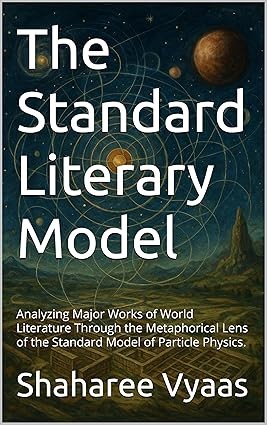
| Kindle eBook publishing Submitted on November 19, 2025 | $3.00 USDView on Amazon ASIN: B0G2YTJK5Y |
| PaperbackLive Updates in review Submitted on November 20, 2025 | $9.99 USDView on Amazon ASIN: B0G31YM7GR |

 The Maharajagar