
The Vedas operate like foundational field equations: hymns that set cosmological symmetries, ritual operators, and priestly mediators that maintain the sacrificial vacuum. Their liturgies are bosonic actions transmitting sacred charge between human and cosmic realms. The sacrificial system establishes selection rules that regulate social stratification and perform energy transfers (offerings), preserving cosmic order (ṛta). In SLM metaphors, the Vedas anchor cultural Higgs modes: perform the right ritual couplings and individuals and kings gain legitimacy and prosperity; fail, and the vacuum destabilizes, producing famine, war, or cosmic malaise. Their influence on later literature is akin to a persistent background field shaping narrative possibilities.
The Vedas are peak Mythoplasma: cosmic hymns where Narraton (N) and Metaphoron (Mγ) weave a universe into being. Ritual time is heavily Temporalon (T)-driven—cyclic, recursive, eternal. Polyphonon (P³) radiates through priestly voices and layered compilations. Conflict isn’t dramatic but metaphysical: Dissonatons (D±) appear as struggles between order and chaos, speech and silence. Silention (S⁰) holds the ineffable—truths only hinted through mantra. The Vedas function like the universe’s gauge symmetry text: ritual as physics, hymn as field equation.
Fundamental Particles
| Particle | Symbol | Function |
| Narraton | N | The basic storytelling particle. |
| Metaphoron | Mγ | The carrier of imagery; analogous to a photon. |
| Dissonaton | D± | Conflict, rupture, contradiction. |
| Silention | S⁰ | The unsaid, the erased. Appears only via absence. |
| Polyphonon | P³ | Multi-voiced narration; binds communities. |
| Temporalon | T | Manipulates chronology. |
Symmetry Breaking as Pivotal Plot Turn or Transformation
Symmetry breaking is the process by which uniformity fractures, giving rise to variety and unpredictability. Within literature, these are the crucial turning points—epiphanies, reversals, or crises—that propel the narrative into new, unforeseen territory. In “Dubliners,” the story “Araby” pivots on a moment of disillusionment, shattering the protagonist’s innocence and transforming the emotional landscape. Similarly, in “Crime and Punishment,” Raskolnikov’s confession marks a critical symmetry break, leading to a profound moral and narrative transformation. Such moments drive creative evolution in both physical and literary systems.
By drawing out these correspondences in structured prose, we articulate a fresh interpretive framework—one attuned to the elegant symmetries, intricate interactions, and transformative shocks that animate both the cosmos and the written word. Each pairing will be explored in detail through forthcoming case studies, revealing both the practical power and the subtle limits of this metaphorical apparatus in literary analysis.
Composite Particles
(Produced when fundamental particles bind.)
| Composite | Composition | Literary Equivalent |
| Mythoplasma | N + Mγ + T | Myth, epic cycles, cosmologies. |
| Realiton | N + D± | Realist narrative, social conflict. |
| Memoirion | N + S⁰ + T | Memory narrative, trauma narrative. |
| Fictionon | N + Mγ | The creative continuum. |
| Critical Gluon | P³ + D± | The force binding literary traditions. |
For Further Reading see:
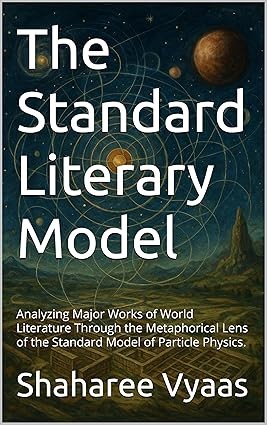
| Kindle eBook publishing Submitted on November 19, 2025 | $3.00 USDView on Amazon ASIN: B0G2YTJK5Y |
| PaperbackLive Updates in review Submitted on November 20, 2025 | $9.99 USDView on Amazon ASIN: B0G31YM7GR |

 The Maharajagar
Wow, that sounds like an awesome book, very cool post. I really like your charts.
LikeLike
Thank you for your appreciation Amelia. The Vedas were meticulously preserved as an oral tradition for millennia before being written down. The charts are embedded in an effort to add a new dimension to literary criticism as described in the Standard Literary Model (SML).
LikeLiked by 1 person
Wow, very interesting, thanks for inspiring, preservations and study of early oral records and languages is necessary to us all. I wonder how many of our current standards filtered down from charts like these?
LikeLiked by 1 person
In modernist works, where fragmentation is a defining characteristic, such motifs offer subtle cohesion and the SLM invites the reader to search for hidden structures amid the disjunction.
LikeLiked by 1 person
Subtlety in motif and motive is easily distorted in some modern literary analysis, I appreciate the work toward a better critical model for recognizing modem and motif accurately, I’m excited to read more.
LikeLiked by 1 person