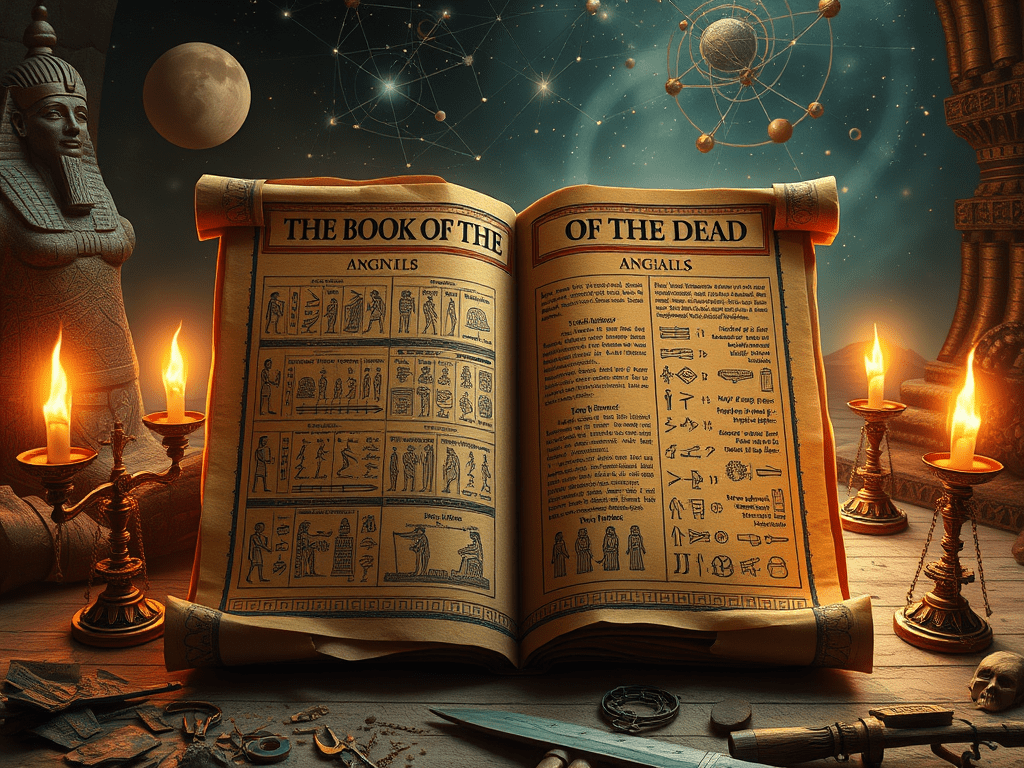
The Book of the Dead functions as a manual for traversing the post-mortem vacuum: a set of boundary conditions and selection rules for the soul-field’s passage through the underworld. Each spell is a local operator altering the probability amplitude of safe passage—preserving identity-mass against decay. The heart-weighing scene is a literal measurement device: the scales act as detectors comparing the soul’s mass against cosmological truth. The erasure of names or the wrong incantation changes allowed decay channels, producing annihilation into chaos. The text’s ritual grammar is the Higgs field of funerary culture: perform the right couplings and the deceased acquires continued social weight in the afterlife; fail, and the particle dissolves. As an SM metaphor, the Book prescribes the conservation laws for moral charge and offers a deterministic algorithm for surviving beyond experimental uncertainty.
This text is saturated with Mythoplasma (N + Mγ + T): spells, gates, and divine judgment arranged in ritual time. Metaphorons (Mγ) dominate — every object and utterance acts symbolically. Temporalons (T) collapse mortal time into eternal afterlife sequences. Silention (S⁰) haunts the work through unspoken fears about identity after death. Dissonatons (D±) emerge in the soul’s trials, while Polyphonon (P³) surfaces through collective religious authorship. The text acts like a symbolic particle accelerator guiding the soul through cosmic symmetry states.
Fundamental Particles
| Particle | Symbol | Function |
| Narraton | N | The basic storytelling particle. |
| Metaphoron | Mγ | The carrier of imagery; analogous to a photon. |
| Dissonaton | D± | Conflict, rupture, contradiction. |
| Silention | S⁰ | The unsaid, the erased. Appears only via absence. |
| Polyphonon | P³ | Multi-voiced narration; binds communities. |
| Temporalon | T | Manipulates chronology. |
Symmetry Breaking as Pivotal Plot Turn or Transformation
Symmetry breaking is the process by which uniformity fractures, giving rise to variety and unpredictability. Within literature, these are the crucial turning points—epiphanies, reversals, or crises—that propel the narrative into new, unforeseen territory. In “Dubliners,” the story “Araby” pivots on a moment of disillusionment, shattering the protagonist’s innocence and transforming the emotional landscape. Similarly, in “Crime and Punishment,” Raskolnikov’s confession marks a critical symmetry break, leading to a profound moral and narrative transformation. Such moments drive creative evolution in both physical and literary systems.
By drawing out these correspondences in structured prose, we articulate a fresh interpretive framework—one attuned to the elegant symmetries, intricate interactions, and transformative shocks that animate both the cosmos and the written word. Each pairing will be explored in detail through forthcoming case studies, revealing both the practical power and the subtle limits of this metaphorical apparatus in literary analysis.
Composite Particles
(Produced when fundamental particles bind.)
| Composite | Composition | Literary Equivalent |
| Mythoplasma | N + Mγ + T | Myth, epic cycles, cosmologies. |
| Realiton | N + D± | Realist narrative, social conflict. |
| Memoirion | N + S⁰ + T | Memory narrative, trauma narrative. |
| Fictionon | N + Mγ | The creative continuum. |
| Critical Gluon | P³ + D± | The force binding literary traditions. |
For Further Reading see:
| Kindle eBook publishing Submitted on November 19, 2025 | $3.00 USDView on Amazon ASIN: B0G2YTJK5Y |
| PaperbackLive Updates in review Submitted on November 20, 2025 | $9.99 USDView on Amazon ASIN: B0G31YM7GR |

 The Maharajagar