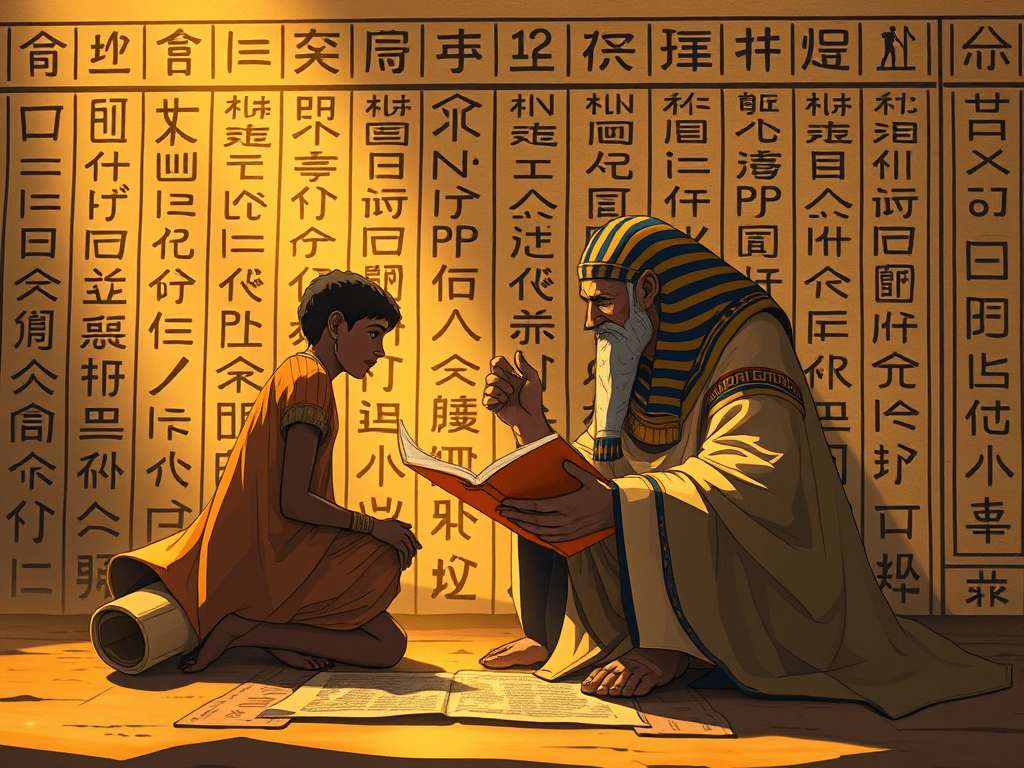
The Instruction of Ptahhotep is a low-energy effective theory: a compact Lagrangian of social rules that regulate interaction in an Egyptian legal-gauge. Its aphorisms act like conserved currents—protocols that minimize conflict and stabilize the civic vacuum. Each proverb functions as a mediated interaction (gauge boson) transmitting authority from elder to younger generations. The “mass” these sayings confer is behavioral—measurable in reputation and access to power. The text’s elegance is its renormalization: by compressing varied social situations into general maxims, it removes divergent behaviors (ego, excess) and returns the system to a stable baseline. Reading Ptahhotep is like sampling a perfectly tuned control system: small couplings, slow dynamics, and clear conserved quantities. The instruction thereby offers social engineers a toolkit for maintaining low-entropy order in a complex human lattice.
A work powered by Realiton (N + D±) but framed by Metaphoron (Mγ): wisdom sayings polished into ethical force carriers. The structure is almost pure Narraton (N), but each maxim gains weight only through social tension (D±)—the struggle between proper conduct and human folly. Silention (S⁰) appears in the text’s gaps: it implies more than it states, assuming cultural knowledge. Temporalon (T) functions lightly, cycling advice across generations. The whole reads like an ethical field theory: Ptahhotep mediates social order with the soft Polyphonon (P³) of shared moral voice.
Fundamental Particles
| Particle | Symbol | Function |
| Narraton | N | The basic storytelling particle. |
| Metaphoron | Mγ | The carrier of imagery; analogous to a photon. |
| Dissonaton | D± | Conflict, rupture, contradiction. |
| Silention | S⁰ | The unsaid, the erased. Appears only via absence. |
| Polyphonon | P³ | Multi-voiced narration; binds communities. |
| Temporalon | T | Manipulates chronology. |
Symmetry Breaking as Pivotal Plot Turn or Transformation
Symmetry breaking is the process by which uniformity fractures, giving rise to variety and unpredictability. Within literature, these are the crucial turning points—epiphanies, reversals, or crises—that propel the narrative into new, unforeseen territory. In “Dubliners,” the story “Araby” pivots on a moment of disillusionment, shattering the protagonist’s innocence and transforming the emotional landscape. Similarly, in “Crime and Punishment,” Raskolnikov’s confession marks a critical symmetry break, leading to a profound moral and narrative transformation. Such moments drive creative evolution in both physical and literary systems.
By drawing out these correspondences in structured prose, we articulate a fresh interpretive framework—one attuned to the elegant symmetries, intricate interactions, and transformative shocks that animate both the cosmos and the written word. Each pairing will be explored in detail through forthcoming case studies, revealing both the practical power and the subtle limits of this metaphorical apparatus in literary analysis.
Composite Particles
(Produced when fundamental particles bind.)
| Composite | Composition | Literary Equivalent |
| Mythoplasma | N + Mγ + T | Myth, epic cycles, cosmologies. |
| Realiton | N + D± | Realist narrative, social conflict. |
| Memoirion | N + S⁰ + T | Memory narrative, trauma narrative. |
| Fictionon | N + Mγ | The creative continuum. |
| Critical Gluon | P³ + D± | The force binding literary traditions. |
For Further Reading see:
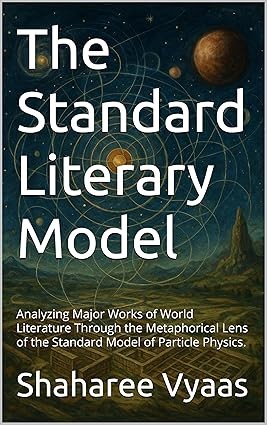
| Kindle eBook publishing Submitted on November 19, 2025 | $3.00 USDView on Amazon ASIN: B0G2YTJK5Y |
| PaperbackLive Updates in review Submitted on November 20, 2025 | $9.99 USDView on Amazon ASIN: B0G31YM7GR |

 The Maharajagar