
The Tale of Sinuhe reads as an early field-theory experiment in identity and exile. Sinuhe is a fermionic excitation displaced from the Egyptian vacuum by war and rumor; his wandering through Levantine courts resembles a particle propagating through different media with varying coupling constants—hospitality, dishonor, foreign custom. Egypt itself functions as a dominant Higgs-like background field: its rituals, kingship, and funerary order endow returning subjects with social mass. Sinuhe’s yearning for home is a long-range potential pulling him back into the original ground state; his eventual return and reintegration represent a symmetry restoration, where prior perturbations are absorbed into the cultural vacuum. The narrative’s stability stems from its conservative charges—family, memory, ritual—that remain conserved across displacement. In SM terms, Sinuhe’s life is a scattering experiment whose final state resolves into the measured, socially recognized identity.
Sinuhe mixes Memoirion (N + S⁰ + T) with Realiton (N + D±): a personal flight shaped by fear, exile, and political rupture. The text hinges on Silention (S⁰) — Sinuhe never states why he fled, creating a gravitational narrative absence. Chronology shifts through Temporalons (T) as life in foreign lands contrasts with yearning for home. Dissonatons (D±) appear in identity conflict and cultural negotiation. Imagery (Mγ) frames Egypt as a metaphoric “center of gravity,” drawing Sinuhe back. The piece stays formally quiet, relying more on social Realiton than Mythoplasma, making it an early psychological narrative held together by a subtle Critical Gluon (P³ + D±) of state, self, and story.
The Literary Particles of the Standard Literary Model
Each “particle” corresponds to a literary function, genre, or symbolic force.
Fundamental Particles
| Particle | Symbol | Function |
| Narraton | N | The basic storytelling particle. |
| Metaphoron | Mγ | The carrier of imagery; analogous to a photon. |
| Dissonaton | D± | Conflict, rupture, contradiction. |
| Silention | S⁰ | The unsaid, the erased. Appears only via absence. |
| Polyphonon | P³ | Multi-voiced narration; binds communities. |
| Temporalon | T | Manipulates chronology. |
Symmetry Breaking as Pivotal Plot Turn or Transformation
Symmetry breaking is the process by which uniformity fractures, giving rise to variety and unpredictability. Within literature, these are the crucial turning points—epiphanies, reversals, or crises—that propel the narrative into new, unforeseen territory. In “Dubliners,” the story “Araby” pivots on a moment of disillusionment, shattering the protagonist’s innocence and transforming the emotional landscape. Similarly, in “Crime and Punishment,” Raskolnikov’s confession marks a critical symmetry break, leading to a profound moral and narrative transformation. Such moments drive creative evolution in both physical and literary systems.
By drawing out these correspondences in structured prose, we articulate a fresh interpretive framework—one attuned to the elegant symmetries, intricate interactions, and transformative shocks that animate both the cosmos and the written word. Each pairing will be explored in detail through forthcoming case studies, revealing both the practical power and the subtle limits of this metaphorical apparatus in literary analysis.
Fundamental Particles
| Particle | Symbol | Function |
| Narraton | N | The basic storytelling particle. |
| Metaphoron | Mγ | The carrier of imagery; analogous to a photon. |
| Dissonaton | D± | Conflict, rupture, contradiction. |
| Silention | S⁰ | The unsaid, the erased. Appears only via absence. |
| Polyphonon | P³ | Multi-voiced narration; binds communities. |
| Temporalon | T | Manipulates chronology. |
Symmetry Breaking as Pivotal Plot Turn or Transformation
Symmetry breaking is the process by which uniformity fractures, giving rise to variety and unpredictability. Within literature, these are the crucial turning points—epiphanies, reversals, or crises—that propel the narrative into new, unforeseen territory. In “Dubliners,” the story “Araby” pivots on a moment of disillusionment, shattering the protagonist’s innocence and transforming the emotional landscape. Similarly, in “Crime and Punishment,” Raskolnikov’s confession marks a critical symmetry break, leading to a profound moral and narrative transformation. Such moments drive creative evolution in both physical and literary systems.
By drawing out these correspondences in structured prose, we articulate a fresh interpretive framework—one attuned to the elegant symmetries, intricate interactions, and transformative shocks that animate both the cosmos and the written word. Each pairing will be explored in detail through forthcoming case studies, revealing both the practical power and the subtle limits of this metaphorical apparatus in literary analysis.
Composite Particles
(Produced when fundamental particles bind.)
| Composite | Composition | Literary Equivalent |
| Mythoplasma | N + Mγ + T | Myth, epic cycles, cosmologies. |
| Realiton | N + D± | Realist narrative, social conflict. |
| Memoirion | N + S⁰ + T | Memory narrative, trauma narrative. |
| Fictionon | N + Mγ | The creative continuum. |
| Critical Gluon | P³ + D± | The force binding literary traditions. |
For Further Reading see:
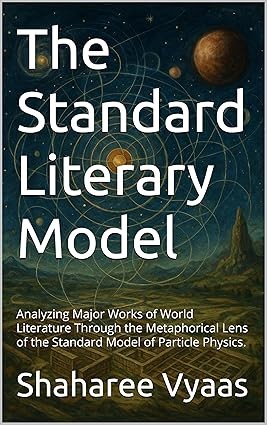
| Kindle eBook publishing Submitted on November 19, 2025 | $3.00 USDView on Amazon ASIN: B0G2YTJK5Y |
| PaperbackLive Updates in review Submitted on November 20, 2025 | $9.99 USDView on Amazon ASIN: B0G31YM7GR |

 The Maharajagar