
Gilgamesh is a prototypical heavy excitation resisting mortality. Enkidu’s entrance turns the two into a bound pair, like a baryonic composite stabilized by intense mutual coupling. Enkidu’s death is a perturbation that shifts Gilgamesh’s vacuum: the hero gains existential mass—grief, wisdom—forcing a search for permanence (immortality) that results in a renormalized appreciation of the communal order. The epic’s cosmos contains deities as long-range gauge fields influencing mortal trajectories, and the flood episode is a cosmological resetting—a high-energy event changing permissible states. Gilgamesh thus models the shift from heroic hubris to socially coherent identity: the narrative is an experimental protocol measuring the cost of immortality against the conservation of human bonds.
At its core, Gilgamesh runs on Mythoplasma (N + Mγ + T): a mythic cycle shaped by heroic narration (N), dense symbolic imagery (Mγ) like the Cedar Forest or the Bull of Heaven, and temporal elasticity (T) that bends mortal and divine time. Conflict with Enkidu and mortality pulses through Dissonatons (D±), while Silention (S⁰) lingers in the unspoken grief shaping Gilgamesh’s emotional arc. The gods act as Metaphorons (Mγ) linking human and cosmic planes. The story’s structural cohesion relies on Polyphonon (P³) through tablets, scribes, and oral layers. Ultimately, the epic’s symmetry breaks when heroic bravado collapses into existential dread, transforming Gilgamesh’s “mass” — his narrative weight — in true Higgs-sector fashion.
Fundamental Particles
| Particle | Symbol | Function |
| Narraton | N | The basic storytelling particle. |
| Metaphoron | Mγ | The carrier of imagery; analogous to a photon. |
| Dissonaton | D± | Conflict, rupture, contradiction. |
| Silention | S⁰ | The unsaid, the erased. Appears only via absence. |
| Polyphonon | P³ | Multi-voiced narration; binds communities. |
| Temporalon | T | Manipulates chronology. |
Symmetry Breaking as Pivotal Plot Turn or Transformation
Symmetry breaking is the process by which uniformity fractures, giving rise to variety and unpredictability. Within literature, these are the crucial turning points—epiphanies, reversals, or crises—that propel the narrative into new, unforeseen territory. In “Dubliners,” the story “Araby” pivots on a moment of disillusionment, shattering the protagonist’s innocence and transforming the emotional landscape. Similarly, in “Crime and Punishment,” Raskolnikov’s confession marks a critical symmetry break, leading to a profound moral and narrative transformation. Such moments drive creative evolution in both physical and literary systems.
By drawing out these correspondences in structured prose, we articulate a fresh interpretive framework—one attuned to the elegant symmetries, intricate interactions, and transformative shocks that animate both the cosmos and the written word. Each pairing will be explored in detail through forthcoming case studies, revealing both the practical power and the subtle limits of this metaphorical apparatus in literary analysis.
Composite Particles
(Produced when fundamental particles bind.)
| Composite | Composition | Literary Equivalent |
| Mythoplasma | N + Mγ + T | Myth, epic cycles, cosmologies. |
| Realiton | N + D± | Realist narrative, social conflict. |
| Memoirion | N + S⁰ + T | Memory narrative, trauma narrative. |
| Fictionon | N + Mγ | The creative continuum. |
| Critical Gluon | P³ + D± | The force binding literary traditions. |
For Further Reading see:
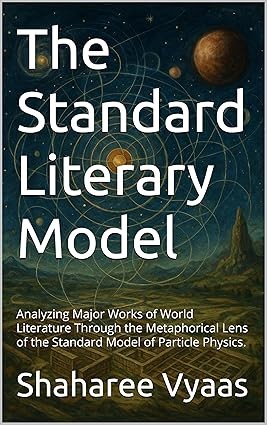
| Kindle eBook publishing Submitted on November 19, 2025 | $3.00 USDView on Amazon ASIN: B0G2YTJK5Y |
| PaperbackLive Updates in review Submitted on November 20, 2025 | $9.99 USDView on Amazon ASIN: B0G31YM7GR |

 The Maharajagar