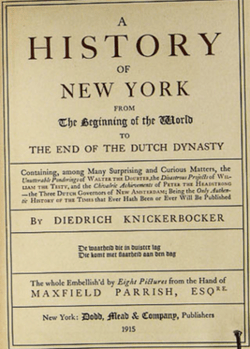
1810 – 1840 is known as the Knickerbockers’ Era of American literature. The name comes from “A History of New York” by Dietrich Knickerbocker, a pseudonym of Washington Irving. It was a humorous rather than a serious history of the city. He invented many of the events and legends he wrote about in the book. “The Sketch Book” (1819) contains two of the best loved stories from American literature, The Legend of Sleepy Hollow & Rip Van Winkle. It was based on old German folk tales filled with the local color of New York’s Hudson River Valley. Irving regarded the story as “a frame on which I sketched my materials”. Neither Irving nor any of the other Knickerbockers really tried to speak for the whole country. For them the world tended to stop at the borders of the New York State.
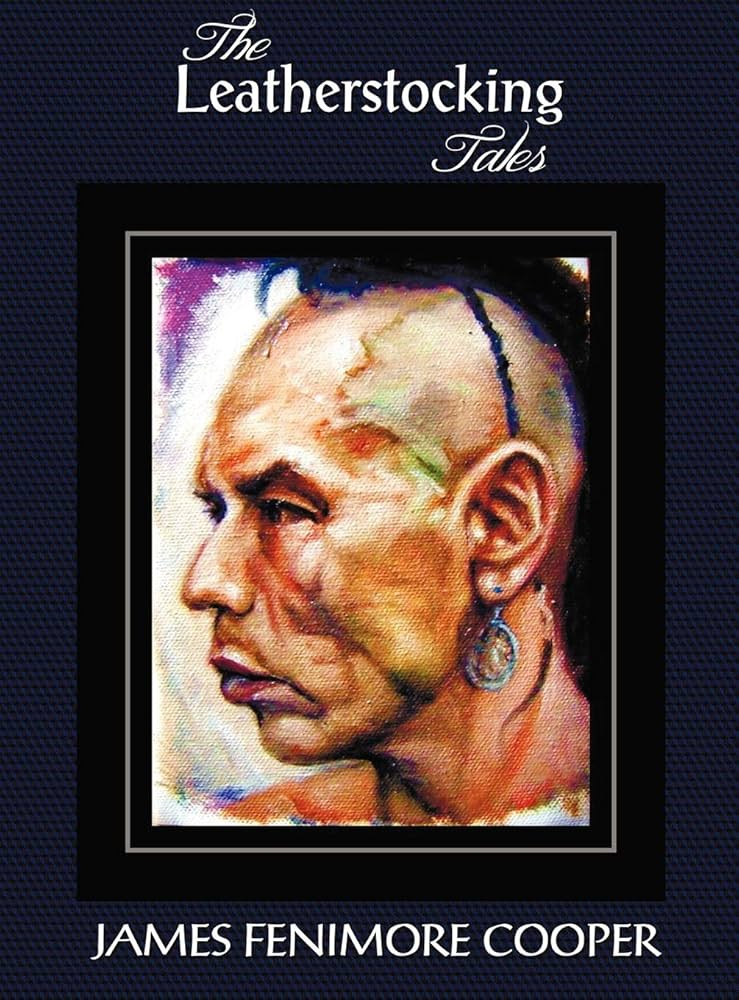
The victory of time and civilization is beautifully described by J.F. Cooper. Natty Bumppo appears in all of his novels and is one of the best-known characters in American Literature. Nathaniel “Natty” Bumppo was a child of white parents who grew up among the Native Americans. He criticized the wastefulness embodied in the settlers and demonstrated a way of life that was a synopsis of man and nature in the West. Also, in Bryant’s Thanatopsis (North American Review, September 1817), the life of man is part of the nature as whole, and death is the absolute end of the individual.
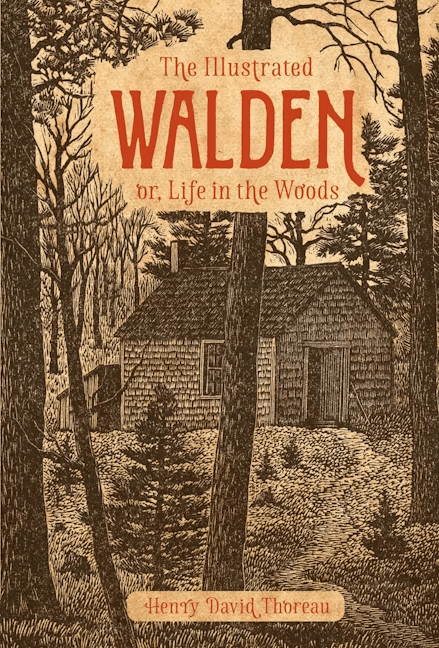
In the 1830 – 1840’s the frontier of American society was quickly moving to the West. At this time, Boston and its neighboring towns and villages were filled with intellectual activities. In the center of these activities were the Transcendentalists. The Transcendentalists tried to find the truth through feeling and intuition, rather than through logic. In their vision “Wisdom does not inspect, it beholds” (Thoreau). Thoreau’s most famous book was Walden (1854). Apparently, it speaks only of the particular side of living alone in the woods, but in fact it is a completely Transcendentalist work. He was convinced that while civilization has been improving our homes, it has not equally improved those who live in them. He observed that the mass of humankind lead lives of quiet desperation and wrote on that subject; “As if you could kill time without injuring eternity”.
Emerson stated in a publication (Nature) that man should not see nature merely as something to be used; that man’s relationship with nature transcends the idea of usefulness. First Emerson would “deposit” ideas in his journal (which he called his bank account) and then he developed his lectures from the notes in his journal. Self-Reliance (1841); to believe in your own thought, to believe what is true for you in your heart is true for all man, – that is genius. He believed that to be great is to be misunderstood and considered a foolish consistency as the hobgoblin of little minds.
In “The Over-Soul” (1841) he claimed that “We live in succession, in division, in parts, in particles. Meantime within man is the soul of the whole; the wise silence; the universal beauty, to which every part and particle is equally related, the eternal ONE. And this deep power in which we exist and whose beatitude is all accessible to us, is not only self-sufficing and perfect in every hour, but the act of seeing and the thing seen, the seer and the spectacle, the subject and the object, are one. We see the world piece by piece, as the sun, the moon, the animal, the tree; but the whole, of which these are shining parts, is the soul” (cit.).

 The Maharajagar