
20 March 2015
It was my intent to read the “The Diary of a Madman and other stories by Xun Lu” , but when I did a little research on this title I found out that “The Diary of a Madman” was the first short story of a book called “Call to Arms” written by Xun Lu around 1918.
It was described as being inspired by Michael Gogol’s short story “The Diary of a Madman” and as an ironic attack on traditional Chinese culture and Confucianism in particular. Since I know barely something about Confucianism, a humanistic doctrine that has dominated ethical, philosophical, cultural and social thinking in China for centuries, I felt not apt to read a criticism upon a subject that I know only superficially.
Instead I switched this title for the above mentioned Five Classics of the “Confucian” (551-479 BC) canon—the Book of Changes, the Book of History, the Book of Rites, the Book of Songs and the Spring and Autumn Annals. All candidates for a position into the imperial bureaucracy from 115 BC till 1905 AC had to pass an exam on these subjects.
Introduction
The Book of Poetry is a collection of 305 texts reflecting everyday life in court and countryside during the Eastern Zhou period; the same collection includes a series of hymns, composed for dealing with a range of issues, including love and marriage, agricultural concerns and war.
The Book of History purports to be a collection of archaic archival materials over 58 chapters that preserve important edicts and memorials outlining the responsibilities of the ruling elite toward Heaven and the common people. It relates the story of the early sage-kings Yao and Shun, the history of the Xia, Shang and Zhou dynasties.
The Book of Rites contains the the three Rites classics, the Ceremonials (Yili), Rites Records (Liji), and Zhou Rites (Zhouli), include as many as three thousand discrete rules of conduct, in addition to fabulous descriptions of an ideal government structure and anecdotes about paragons of Confucian virtue. Proper ritual conduct would keep the empire in harmony, as well as emphasize the virtue of piety.
The book of Changes can be read as a divination manual eventually expanded for use as a philosophical text, because it attempts to recreate through its graphic symbols and attached texts the full range of shifting phenomena that proceed from the unitary prime mover, the Dao and is centered around the principles of yin and yang. It’s still in use for divination practices and has been translated as I Ching.
The Spring and Autumn Annals is a court diary detailing the activities of the rulers of the small state of Lu during the years 722-481 BC and appears to have been written specifically for annalistic purposes.
The most important underlying idea in Confucianism was the perfectibility of human beings through Shu (profound empathy) leading to Ren (human kindness). Such developed humanity was typically realized by a two-step process: unremitting study of the Way of the Ancients, which ensured a gradual habituation to goodness through immersion in the ancient models preserved in ritual, to be crowned by a profound awareness of one’s place within the community of civilized human beings.
The Confucian model of Civilization is both embodied in and enhanced through the distinctive ritual acts that inevitably govern most aspects of human interaction; if those in power would only take the trouble to express their human feelings through time-honored rituals, there would be no need for repressive penal codes and punishments to control the bestial impulses.
Just like so many other teachings, Confucianism postulates the existence of a Golden Age and situates it during the early days of the Western Zhou dynasty (1050 -770 BC). The restoration of that Golden Age might be better led by men of noble character than by men of noble birth.
Humankind needed only to become so adept in the ritual usages, the verbal and gestural language for dignified human interaction, so that cultivation became virtually second nature, at once spontaneous and graceful. Lower humans would still require the loving support of a strong family system and the suave model of a just ruler to arrive at a corresponding nobility of character.
A fundamental adagio of Confucianism is that all humans are capable of becoming insofar as they learn to weigh their relative claims on goods and to find the single most humane solution to problems arising from social interaction, called the Perfection of the Middle Way.
In the 12th century, during the Song dynasty, there was a fundamental reconsideration of early classical learning, which represented a virtual reassessment and reinvention of the Confucian message. Specifically the content of the original Five Classics should be compared with the Four Books favored by later Confucian masters to argue the deification of the Emperor (where did we hear that before).
A rediscovery of early classicism must serve to dispel lingering stereotypes about an eternal and unchanging China. Only the classics as a group can reveal the original Confucian vision upon the entire workings of the divine Way and its operation within human society.
The Han view was that the Five Classics are not only tightly integrally connected texts but also texts that weave together the constant principles underlying the socio-cosmic fabric. The Han classical masters devised following rules to determine whether a work qualifies as a true Classic or set of classics;
• It must constitute a complete and perfect order of sufficient breadth to answer every moral question put to it;
• the classic must be “easy to know” and “easy to follow” in the sense that it contains no “treachery or trickery,” that is, no internal contradictions;
• the classic must be eternally relevant in the ever changing present, so that its traditions remain alive in every generation;
• The classic must function as a kind of access route to the ethical makeup of its sage author(s), providing models of inner strength and integrity, if not conventional power;
• on both the literary and ethical levels, reading of the classics must yield such reliably exquisite pleasures as to forge in the most knowledgeable adherents—the connoisseurs of morality—the strong desire to emulate the ethical exemplars of the past.
21 March 2015
Dong Zhongshu, a Han master who lived between 174 – 104 BC gave the following description of the classics;
Each and every one of the six branches of learning is great, but each has that in which it excels.
• The Book of Poetry tells of the aspirations of the heart and mind; therefore, it excels in substance.
• The Book of Rites mandates moderation; therefore, it excels in refinement.
• The Book of Music intones virtue; therefore, it excels in influence.
• The Book of History illustrates merit; therefore, it excels in human affairs.
• The Changes bases itself in Heaven and Earth; therefore, it excels in regularities (shu ).
• The Spring and Autumn rectifies notions of right and wrong; therefore, it excels in governance.
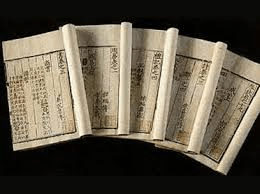
In the mid- to late Western Han, centuries later, a scholastic impulse to group things by fives, in imitation of the Five Phases worked to suppress mention of a Book of Music classic in connection with the corpus, resulting in the incorporation of a music text into a text on rites.
Comments
Just like the Mahabharata, the corpus of the Five Classics was unusual in the degree to which it remained open, subject to continual amplification and revision. It lent a sturdy framework within which to construct aesthetic experience and cultural ideals, even when individual writings in the canon and attached commentaries clearly reflected the contemporary preoccupations of their separate authors. Confucius himself taught that true learning consists of “reanimating the old” through the creative adaptation of core behavioral modes to changing circumstances.
Confucianism promotes five constants for the personal development of virtue and the upholding of ethics. The basic Confucian ethical concepts include Ren, Yì, lǐ, Zhì and Xin. Ren is an obligation of altruism towards other individuals. Yi is the obligation to be righteous and benevolent. Li is a ritual system of norms that defines how a person should properly act in daily life and defines the rules for proper government. Zhi is the ability to judge what is right or wrong on other people’s behavior and to strive for knowledge and understanding. Finally there is Xin who encourages the adept of Confucianism to live and act into a way that is cohesive with his thinking and beliefs.
There are still many other virtues, but these were the most important ones while Ren and Yi are considered to be the capital virtues and those who’re not living by it are considered lesser humans. Those who manage to live by these five constants are called Junzi (an English equivalent would be a gentleman).
Then there are the four sizis for a good functioning society; Loyalty, Filial Piety, Continence and Righteousness. Zhōng (loyalty); the minister has to be loyal to his prince but reciprocally the prince has the obligation to be righteous. Xiào (filial piety); if there is one virtue that can be found back into all Asian religions, it are the obligations that one has towards his parents and family.
Jié (continence); everybody should know his place into the world and behave accordingly. Yì (righteousness); this virtue is also part of the five constants, described in previous paragraph. Following Confucius social disorder is a result of not understanding the reality and order of things so that above principles are badly applied. He conceded that into times of social unrest loyalty and filial piety could become conflicting virtues.
22 March 2015
Around the 12th century under the impulse of Zhu Xi (1130 – 1200) Confucianism underwent a reformation by lying more emphasis upon The Four Books than upon The Five Classics.
The Four Books are lifting certain texts out of the Five Classics by considering as more important. Since they were written only a couple of hundred years before, their language was not so archaic and their content was more coherent and less voluminous that of the Five Classics.
Whereas the Five classics put more weight on good rule, the Four Books emphasized more upon self-cultivation as a first and necessary step to improve the World.
Zhu Xi proclaimed to his students “Not the places where you have questions, but rather the places where you have none: that is where you should focus your energies.” Zhu Xi’s teaching method was based upon following principles;
• To reduce the amount of texts his students had to read
• To make them recite what they were reading till they knew it by heart
• To apply that knowledge into their daily lives.
Zhu Xi grew also more and more impatient with the already since centuries going on debate of the correct way to interpret the Classics to find out about the Middle Way and decided to settle the dispute for once and for ever by making The Four Books the new canon of Confucianism.
Only in 1756 would the Classics regain some of their earlier influence when the state examination system placed them back on equal foot with the Four Books.
However during the early 20th century, activists accused scholars who studied the Classics of elitism. Again the status of the Five Classics declined to a secondary canon and has since then never regained their importance for the study of the Middle Way.

 The Maharajagar