
The Life and Opinions of Tristram Shandy, Gentleman by Laurence Sterne.
This humorous book has been publicized in nine volumes between December 1759 (vol. 1, 2) and January 1767 (vol. 9). The author was an Anglican clergyman who’s first book “The History of a Good Warm Watch-Coat”, describing the little squabbles and intrigues of church dignitaries, was burned upon request of his embarrassed ecclesial superiors, which caused Sterne to develop an aversion for gravitas. Although barred from advancement, the book made him aware of his writing skills and he decided to compensate his failing chances of advancement by pursuing a second career as an author of satiric novels. The first editor to whom he presented his first volumes turned him down at the worst of times; his mother just died and his wife was terminally ill, which probably softened a little his satirical whim into a more comic tune who’s sometimes flirting with tragedy. When the work finally got published, it made him an instant celebrity and he enjoyed it to be fêted into the highest cultural salons of London. But just like his wife he suffered of tuberculosis and died in 1768, a month after the publication of his second novel, “A Sentimental Journey Through France and Italy”, at the age of 54.
13 March 2015
Volume 1; About the narrator’s conception
Tristram starts his narrative by dedicating a whole chapter to the circumstances surrounding his conception. Following his belief the implantation of the Homunculus (A tiny person inside a sperm) was disturbed because his mother asked his father at that precise moment if he didn’t forget to wind up the clock.
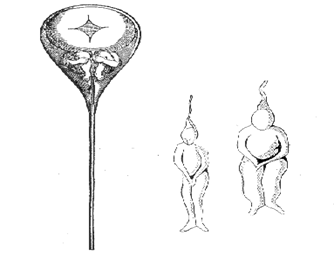
So the whole implantation process of the homunculus went wrong ab ovo (narrator citing Horace). Into the first chapter the narrator would give further indications of his erudition by citing the Essays by Montagne, suggesting an intimate knowledge of the works of Locke, Burgersdicius, Ramus, Cervantes, etc…
Another way that the author used to display his erudition is by constantly inserting sentences like” … and then he would break off in a sudden and spirited Epiphonema, or rather Erotesis …“or “… (a name that) was unison to Nincompoop and every name vituperative under heaven…” These examples came from one page somewhere in the middle of the first volume, when I became aware of how many times I’d used the dictionary function of my Kindle.
He spent also a couple of pages on sneering at colorfully dressed nobles making the roads unsafe by speeding along upon their Hobby-Horses (Another word I had to lookup).
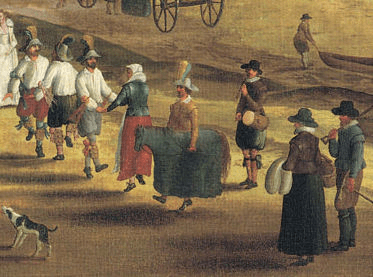
He also makes fun of the local Parson for a couple of pages by comparing the parson’s horse with Don Quixote’s horse Rosinante. It seems that at that time, the best way to make fun of someone was to ridicule their horse. But later on into the chapter, the parson gets good points because he can join the laughter about himself and his horse and is just like the narrator an enemy of gravity that he describes as a deceit “twas a taught trick to gain credit of the world for more sense and knowledge than a man was worth”. The parson, his name was Yorick, was gifted with a great wit but little common sense and a mercurial temperament. Just as happened to the author of this book, he joked a couple of times about the wrong persons. They formed a coalition to destroy him and drove him subsequently into an early grave (the author luckily escaped that fate by becoming a celebrated writer; it was his frail health that caused him to die at 53).

 The Maharajagar