
Chapter 8; The Mahabharata.
March 5, 2015
The title of this book can be translated as “the great tale of the Bhārata dynasty“. It is assumed that the origins of the epic probably fall between the 8th and 9th centuries BCE and that the text probably reached its final form by the early Gupta period (c. 4th century CE). It’s one of the two pillars of the Indian literature; the other one being The Ramayana. The Mahabharata can be described as the longest epic poem ever written; it contains over 100,000 couplets or over 200,000 individual verse lines. A critical edition contained 13.000 pages in 19 volumes was produced between 1919 and 1966 by scholars at the Bhandarkar Oriental Research Institute, Pune. A project to translate the full epic into an English translation is still underway and will cover an estimated 32 volumes of which 15 are already available. I would never have considered to read it if it wouldn’t have been summarized to 141 pages of A4 format.
The further I’m getting into this New Year’s Resolution, the itchier I’m getting. I admit that when I’ve put an idea into my head, I can get a little monomaniac, but how else can you bring to a successful end a difficult task. At the end of the previous paragraph, my wife decided that it was time for us to go to the beach and have a swim, followed by doing some shopping for a party she wants to organize tomorrow at 5pm (some sunset drink combined with some potluck).
The day after that we have to go to a party organized by some other friend (one of my proofreaders) for a repetition of more of the same. Ok, I must admit that if it was not of my wife, I would probably ruin my health and social life by spending my whole day on reading and writing.
Book I; The tournament (Astra Darsana)
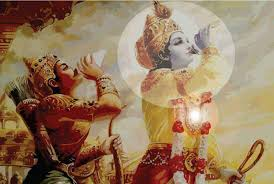
It’s the introduction to the two rivaling clans of paternal cousins; the 5 sons of the deceased King Pandu and the 100 suns of his blind brother Dhrita-rashtra who succeeded him as King. In reality however, the 5 sons of Pandu are fathered by five different Gods. . Yudhishthir was the son of Dharma or Virtue, Bhīma of Vayu or Wind, Arjun of Indra or Rain-god, the twin youngest were the sons of the Aswin twins, and Karna was the son of Surya the Sun, but was believed by himself and by all others to be the son of a simple chariot-driver.
The 100 sons of Vidura, of whom Duryodhan was the eldest, had more demoniacal progenitors and were jealous of the 5 sons of Pandu. To settle things, their father organized a tournament. Arjun, one of the Pandu princes proved to get the upper hand, till an unknown warrior, named Karna, comes into the arena and challenges Arjun. Nobody knew from whom Karna descended, but he was a secret premarital son of Pritha, Arjun’s mother. First the Pandu brothers protest that their brother would have to compete a man with no lineage, but Duryodhan makes him King of Anga, after which he can challenge Arjun. Against all expectations, Karna wins the tournament.

 The Maharajagar