
2. In Search of Lost Time by Marcel Proust.
The original title of this series of books was “A la Recherche du Temps Perdu” and contains the following volumes;
1 Volume One: Swann’s Way,
2 Volume Two: In the Shadow of Young Girls in Flower
3 Volume Three: The Guermantes Way
4 Volume Four: Sodom and Gomorrah
5 Volume Five: The Prisoner
6 Volume Six: The Fugitive
7 Volume Seven: Finding Time Again
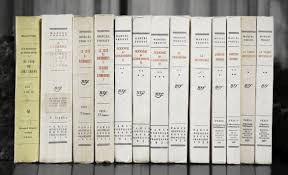
After consulting my favorite online library (www.gutenberg.org), I discovered, to my dismay, that only the first volume, Swann’s Way, was available into an English translation. I started to ponder if I should lose some time, trying to dig up the English translations of the remaining volumes or just read them into the original version.
Finally I decided to give “A l’ombre des jeunes filles en fleurs – Première partie” ( the first part of the French version of “In the shadow of young girls”) a tryout when I finished Swann’s way.
Impressions: There are striking resemblances with Middlemarch, especially by the way that the characters live inside the head of other people instead of inside their own. The end of the first book features probably to most famous lemony cake in literature, in French called “une madeleine”, dipped into some tea, whose taste invoked into the mind of the narrator a whole set of involuntary memories. Like in Middlemarch, the narrator uses a little pedantic pedagogical language, but unlike in Middlemarch, is also a participant into the story.
Resume
The whole series of books is a cascade of involuntary memories of an old man; from his childhood in the fictive town of Combray and the occasional holyday trips to the fictive seaside town resort of Balbec, his discovery of girls, his weak health that plagued him his whole life, his observations on homosexuality and extramarital relations, his constant jalousies, his lifelong struggle to get access to the “right” circles (mostly highly educated bourgeois with artistically ambitions), …
The most disturbing characteristic of the narrator is to long very long from a distance to acquire something, just to lose interest the moment he gets what he wants. This is for example the case with his Albertine; he longed for her when she was a young girl who held him at arm length but when she finally gives in to move with him to Paris, he neglects her while at same time being utterly possessive about her. When she finally runs away (The Fugitive) he plunges into despair but when at the end he receives a telegram of her, he reacts with indifference (made his point). Into the last book, he finally learns how to read people’s signals and the way they communicate their vision upon reality and relate to it. This last ability, into the opinion of the narrator, allowed his vocation, to become a writer, to come to fruition.
Comment
Meanwhile I kept tinkering at my previous manuscripts. Especially the essay is a special needs child and is right now into the phase of proof reading by two friends, both professional writers. The first one has a college degree in English literature and writes children’s books and the second one has a degree in Environmental Science and is a ghost writer of scientifically articles.
Because all of that I still didn’t have time to give proper attention to my Kindle. On top of that, my wife putted me in charge of todays’ dinner, to retrieve a huge cactus from the estate of one of her friends and wants me to assist her by the planting of a coconut tree at sunset. This challenge became a real test of character, especially since she thinks of it as a kind of competitor for my attention.
After finishing the last part of In Search of Lost Times, I decided that I’ve got my monthly dose of human jealousy, betrayal, the death of loved ones and platonic romantics. I wanted to read now something more lighthearted.

 The Maharajagar