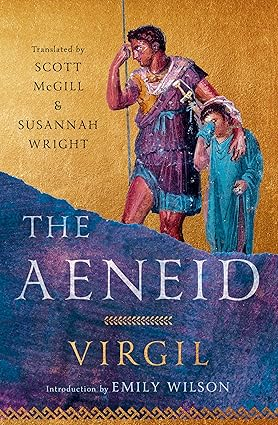
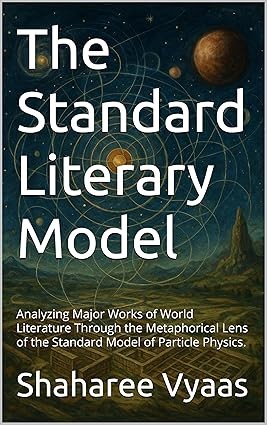
Aeneas is a particle carrying the full momentum of destiny, propelled across collapsing Trojanscape into the unformed vacuum of Italy. His journey resembles a forced trajectory through an unstable potential landscape: propelled by fate, slowed by grief, accelerated by divine interference. Love with Dido forms a temporary bound state—briefly stable, catastrophically broken when the higher symmetry of duty asserts itself. The underworld episode is a descent into a metaphysical collider, where Aeneas encounters ancestral particles and the future debris of Rome. Virgil frames empire as a cosmic inevitability: a structure emerging from long-range forces rather than mortal choice. The poem’s hero is not celebrated for personal brilliance but for being a perfect mediator—an obedient messenger through whom history aligns its vectors. In this physics, victory is not triumph but burden: a mass one carries because the universe demands balance. The Aeneid deploys Mythoplasma, merging Roman destiny with epic cosmology. Narraton structures Aeneas’s journey toward the founding of Rome, while Metaphoron (Mγ) saturates the text with omens, flames, gods, and prophetic visions. Dissonaton (D±) fuels the epic’s tragic momentum—Troy’s fall, Dido’s despair, the Italian war—each a symmetry-breaking event that forces Aeneas toward duty over desire. Temporalon (T) blends past, present, and future: Aeneas witnesses Rome’s imperial future in a temporal field that folds history into epic present. The result is a mythopolitical narrative engineered to give “mass” to Roman identity.
Shaharee Vyaas is a polyvalent cryptomathician. As such he likes to hover above the demarcation zone between Science, Art, and Religion. Where most philosophers perceive the language as the limit of our knowledge, the cryptomathic method crosses the language barriers and stipulates that the unspeakable can be expressed in paintings, music or mathematical equations.
View all posts by Shaharee

 The Maharajagar