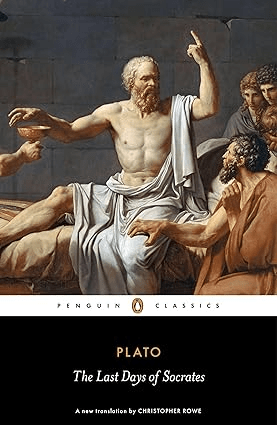
Socrates appears as a stable particle within a decaying moral field, a disruptive force whose questions unsettle the Athenian vacuum. His method—elenchus—is a controlled collision: ideas smashed together until hidden structures emerge. The trial reveals a society terrified of intellectual ionization—fearful that too much inquiry will shatter its fragile civic bonds. Socrates refuses to adjust his charge to appease the court. His death becomes an act of philosophical symmetry: if virtue is knowledge, then dying for truth is the ultimate calibration of theory and action. Plato’s text crystallizes the strange physics of ethics: wisdom does not guarantee survival, only coherence. Socrates’ calm acceptance makes him a particle that refuses annihilation; his field persists through every subsequent age.
The Apology functions as a Realiton (N + D±): a realist-philosophical inquiry structured around conflict—Socrates vs. the polis. Narraton supplies the forensic frame, while Dissonaton (D±) drives the tension between truth-seeking and civic authority. Socrates’ elenctic questioning acts as a controlled release of Dissonaton energy, destabilizing assumptions. Polyphonon (P³) emerges paradoxically through a single speaker: Socrates stages imaginary dialogues, conjuring absent accusers and jurors, creating a multivoiced argumentative field. Silention (S⁰) appears in what the city refuses to hear—its unseen fears and suppressed anxieties about dissent. This S⁰ field gives “mass” to the trial by shaping the unstated motives behind judgment. The result is a narrative charged with ethical gravitation where the meaning of virtue is tested through conflict and refusal.
Fundamental Particles
| Particle | Symbol | Function |
| Narraton | N | The basic storytelling particle. |
| Metaphoron | Mγ | The carrier of imagery; analogous to a photon. |
| Dissonaton | D± | Conflict, rupture, contradiction. |
| Silention | S⁰ | The unsaid, the erased. Appears only via absence. |
| Polyphonon | P³ | Multi-voiced narration; binds communities. |
| Temporalon | T | Manipulates chronology. |
| Composite | Composition | Literary Equivalent |
| Mythoplasma | N + Mγ + T | Myth, epic cycles, cosmologies. |
| Realiton | N + D± | Realist narrative, social conflict. |
| Memoirion | N + S⁰ + T | Memory narrative, trauma narrative. |
| Fictionon | N + Mγ | The creative continuum. |
| Critical Gluon | P³ + D± | The force binding literary traditions. |
For Further Reading see:
| Kindle eBook publishing Submitted on November 19, 2025 | $3.00 USDView on Amazon ASIN: B0G2YTJK5Y |
| PaperbackLive Updates in review Submitted on November 20, 2025 | $9.99 USDView on Amazon ASIN: B0G31YM7GR |

 The Maharajagar