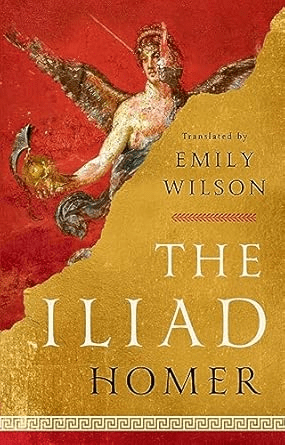
The Iliad is a collision event—two massive bodies (Achilles’ rage and Troy’s stubborn dignity) smashing together in a storm of hadronic debris. The poem behaves like a high-energy scattering experiment in which honor, mortality, and divine interference are particles exchanging momentum with catastrophic results. Achilles is effectively a top quark: heavier than the narrative can comfortably contain, decaying rapidly into consequences. Hector, by contrast, is a stable baryon with well-defined spin and moral isospin, anchoring the poem’s field equations. The gods serve as external gauge fields fluctuating in intensity, bending trajectories, and altering decay channels while never fully violating conservation laws. When Achilles withdraws from battle, the system enters a symmetry-broken vacuum—war continues, but without its defining mass-carrier. Patroclus’ death restores the symmetry violently, releasing the stored potential energy as wrath. The poem models war not as politics but as physics: energy seeking release, force meeting resistance, and glory annihilating itself. Nothing escapes unscathed; everything radiates grief.
The Iliad is a high-energy Mythoplasma with enormous Dissonaton (D±) density — honor, rage, war. Narraton (N) carries heroic arcs while Metaphoron (Mγ) electrifies battle scenes and divine interventions. Temporalon (T) compresses and dilates time around emotional intensities (Achilles’ grief, Hector’s farewell). Silention (S⁰) speaks through everything unsaid — Achilles’ almost-love for Patroclus, the civilian costs. The poem is held together by Polyphonon (P³): gods, warriors, bards, all resonating. Myth, mortality, and rage collide like unstable particles smashing in a collider.
Fundamental Particles
| Particle | Symbol | Function |
| Narraton | N | The basic storytelling particle. |
| Metaphoron | Mγ | The carrier of imagery; analogous to a photon. |
| Dissonaton | D± | Conflict, rupture, contradiction. |
| Silention | S⁰ | The unsaid, the erased. Appears only via absence. |
| Polyphonon | P³ | Multi-voiced narration; binds communities. |
| Temporalon | T | Manipulates chronology. |
Symmetry Breaking as Pivotal Plot Turn or Transformation
Symmetry breaking is the process by which uniformity fractures, giving rise to variety and unpredictability. Within literature, these are the crucial turning points—epiphanies, reversals, or crises—that propel the narrative into new, unforeseen territory. In “Dubliners,” the story “Araby” pivots on a moment of disillusionment, shattering the protagonist’s innocence and transforming the emotional landscape. Similarly, in “Crime and Punishment,” Raskolnikov’s confession marks a critical symmetry break, leading to a profound moral and narrative transformation. Such moments drive creative evolution in both physical and literary systems.
By drawing out these correspondences in structured prose, we articulate a fresh interpretive framework—one attuned to the elegant symmetries, intricate interactions, and transformative shocks that animate both the cosmos and the written word. Each pairing will be explored in detail through forthcoming case studies, revealing both the practical power and the subtle limits of this metaphorical apparatus in literary analysis.
Composite Particles
(Produced when fundamental particles bind.)
| Composite | Composition | Literary Equivalent |
| Mythoplasma | N + Mγ + T | Myth, epic cycles, cosmologies. |
| Realiton | N + D± | Realist narrative, social conflict. |
| Memoirion | N + S⁰ + T | Memory narrative, trauma narrative. |
| Fictionon | N + Mγ | The creative continuum. |
| Critical Gluon | P³ + D± | The force binding literary traditions. |
For Further Reading see:
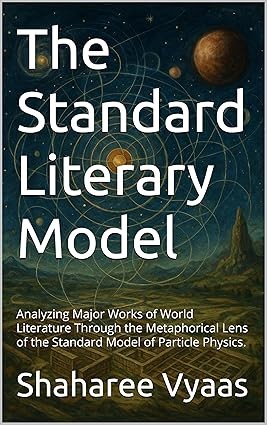
| Kindle eBook publishing Submitted on November 19, 2025 | $3.00 USDView on Amazon ASIN: B0G2YTJK5Y |
| PaperbackLive Updates in review Submitted on November 20, 2025 | $9.99 USDView on Amazon ASIN: B0G31YM7GR |

 The Maharajagar
💙💙💙
LikeLiked by 1 person
Thank you Luisa.
LikeLiked by 1 person
It’s always a pleasure reading your articles!
LikeLike