
I made nine years ago a new year’s resolution to read the Top 100 Works in World Literature by the Norwegian Book Clubs with the Norwegian Nobel Institute. The club polled a panel of 100 authors from 54 countries on what they considered the “best and most central works in world literature.”
I was setting out to read ALL the 100 best books of the world literature in one year and keep a diary of this experience. I soon found out that this wasn’t manageable if you also want to have a real life and not destroy your relationship. So I decided to spread my readings as much as possible over the different continents and timeframes. This resulted in a rather randomly chosen sequence of 23 readings over 365 days.
- Middlemarch by George Eliot.
Day 1. Full of good intentions, I set myself to the task to read Middlemarch by George Eliot. To my dismay I soon discovered that it was not “A” book but a series of eight books;
Book 1; Miss Brooke, Book 2; Old and Young, Book 3; Waiting for death, Book 4; Three love problems, Book 5; The dead hand, Book 6; The widow and the wife, Book 7; Two temptations, Book 8; Sunset and sunrise.
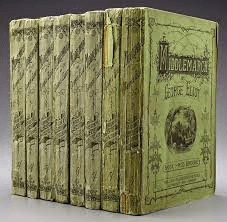
Together good for a monster of 908 pages. Already at the start of this challenge, my resolve started to waver. Anyway, I got off with Miss Brooke into the tale by George Eliot, who by the way wasn’t a man, but the pen name of a woman called Mary Ann Evans.
Introduction
Miss Brooks is a beautiful, talented, intelligent and compassionated young woman, who lived during the beginning of the nineteenth century in a small, fictional, English town called Middlemarch. The subtitle of the book is “A Study of Provincial Life” because it describes with a painstaking accuracy the drives and interactions of the different social actors of a small town into the Midwest of England at that period of time.
At day three I was halfway through the book (series) and got in general a little irritated by all those Victorian people building air castles, just to fall on their face every time when they tried to live into them. My wife reminded me that I got a Kindle book reader for Christmas and that I didn’t touch it since then. Honestly, I was so busy with finishing and revising my previous manuscripts that I didn’t get to read the instructions for it. Tomorrow I definitively will have to make some time free during my allotted read and writing time. At the end, it can facilitate greatly the challenge that I’ve put on myself.
Day 15.
I’m through with Miss Brooks, her family, and townsfolk. Her middleclass family considered her rightfully a little nutty, because she refused a marriage proposal of a local nobleman who owned most of the land in and around the town. Instead she married an older clergyman who pretended to be a scholar in the false hopes that she would be allowed to help him with his academically researches. The guy turns out to be an asshole, but luckily for her he doesn’t live too long and leaves her his fortune on only one condition; that she’ll never marry his nephew. She had of course to marry the nephew and to throw away the fortune. She ended up as the wife of a politician and into the process of doing so, shelved all her ideals and ambitions.
Although most of the book is centered on Marry Brooks, my most preferred personage was the tragic physician, Dr. Lydgate. He wanted to introduce newly conceived medical treatments and to conduct medical research, but he was his own biggest enemy. He thought highly of himself, snubbed on all those who didn’t meet his standards and on country side mentality in general. Of course a medical practitioner with that kind of attitude didn’t go far in a country side town. He married the daughter of the mayor because he hoped it would give him more stature into the community, while she thought that she procured herself a moneymaker and social climber. Instead of that, unpaid bills started to fly in, and she turned his life into hell. They had to leave town in disgrace and deeply indebted. Once resettled in London, he became a gout treating doctor for the affluent; exactly the kind of doctor he never wanted to be. He died early and his wife remarried an elderly man with deep pockets and a lot of patience. Finally a perfect match.
Comment
Finishing the reading of Middlemarch had bolstered my confidence and I decided to take on another monster – In Search of Lost Time by Marcel Proust.

 The Maharajagar